PUPPY DEVELOPMENT CENTER • TREATMENT PROGRAM

Soft Mouth Manners + Puppy Biting Solutions

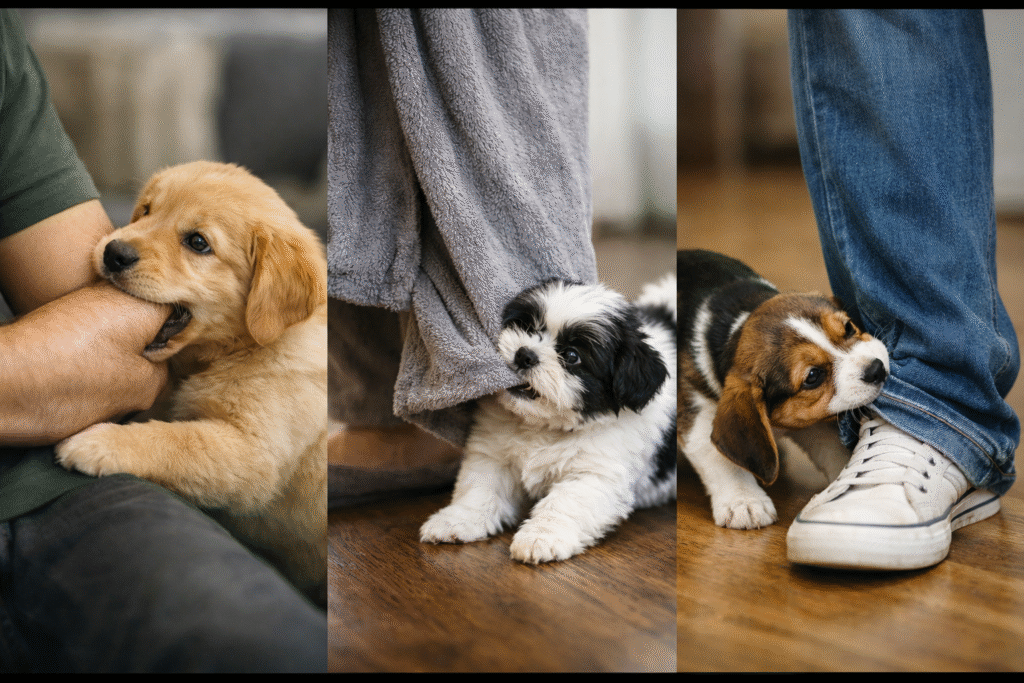
A lot of puppies come into the world as a mouth with paws. They bite when they play, bite when they get excited, bite when they are tired, bite when they are wound up, and bite when your sleeves make a terrible decision and move. That does not mean your puppy is mean. It means your puppy is young, under construction, and learning what their mouth is for. This page helps you teach the difference between normal puppy development and bad habits you do not want following your dog into adulthood.

Quick Start

What To Do First

The second teeth touch skin with pressure, interrupt the moment cleanly and redirect just as fast. No speeches. No wrestling. No dramatic hand-yanking like you’re trying to escape a shark attack in a kiddie pool.

Do this

Use a short, sharp “OUCH!” or “AWRP!”, freeze for a beat, then immediately present a toy and make it interesting.

Do not do this

Do not rip your hand away fast, do not roughhouse with your body, and do not wait three business days to find a toy.

Simple rule: if you do not have a toy ready, you are already late.
Module 1

What This Is + Why It Matters

We are not just “stopping puppy biting.” We are training the mouth. Puppies play bite because they need feedback about pressure so they can learn how much force is too much. That process is what develops bite inhibition.

Why puppies do this

Puppies use their mouths the way toddlers use their hands. They explore, play, teethe, pounce, get overexcited, and sometimes act like your forearm is a reasonable life choice.

Why this matters later

A dog with better mouth control is a safer adult dog. Softer force comes before fewer incidents. That order matters, and the training window does not stay wide open forever.

Age window: this work matters most while your puppy is still young. Do not “wait and see” while hard biting stays alive.
Module 2

How To Do It

This is where timing beats intensity. Every single time. Your puppy does not need a TED Talk. Your puppy needs a fast interruption and a better option.

Step 1 — Interrupt

Use OUCH! or AWRP! loud and sharp enough that the head pulls back. Not a drawn-out “nooooo.” That just becomes background music.

Step 2 — Do not yank away

Fast movement triggers chase and prey drive. Freeze for a beat. Let the puppy be the one to back off first.

Step 3 — Redirect fast

Replace your hand with a toy immediately. Puppies still need to put something in their mouths. We just make sure it is not you.

Step 4 — Repeat cleanly

Human skin ends the fun. Toys keep the fun going. That contrast is the lesson.

What progress looks like: hard bites become less hard, the head pulls back faster, and the puppy re-engages softer before frequency starts dropping.
Module 3

Common Mistakes + What To Do Instead

This is where people accidentally keep puppy biting alive. Open the sections below and clean up the leaks.

“My puppy gets more excited when I yelp.”

Some puppies hear a yelp and think the game just got better. If that happens, stop forcing that method. Go neutral, remove access briefly, and redirect to a toy or a calmer reset instead.

“My puppy bites harder when I move away.”

That usually means your movement is feeding chase behavior. Freeze. Wait for the head to move back. Then redirect. Do not turn yourself into entertainment.

“The kids are getting chewed on.”

Adults supervise, adults interrupt, and adults redirect. Kids are usually too late with timing and too exciting with movement. Puppies often read that as more play, not less.

“We play with hands sometimes. Is that okay?”

No. That muddies the lesson. If hands are toys on Tuesday but illegal on Wednesday, training takes longer. Keep the rule clean: toys are for biting, people are not.

“Can I just redirect every time and skip the feedback?”

Redirecting helps management, but bite inhibition requires feedback. The interrupt matters. Redirect is a tool, not the whole movie.

Module 4

When To Use It + What To Expect

Use this every time teeth hit people with pressure. Not sometimes. Not only when guests come over. The more consistent the message, the faster your puppy understands the rule.

When to use this

  • during play when the mouth leaves the toy
  • during zoomies when ankles become “interesting”
  • around kids and visitors
  • when teething ramps up chewing and grabbing

What to expect

  • improvement is gradual, not magical
  • softer pressure usually comes first
  • some puppies are more persistent than others
  • overtired puppies bite worse
Reality check: a lot of biting is a regulation problem, not a character flaw. Puppies get mouthier when tired, overstimulated, hungry, thirsty, under-supervised, or overdue for a nap or potty break.
Module 5

Quick Tracker + Reminders

Keep this simple. You are just looking for patterns: when the biting happened, how hard it was, what you did, and whether it got softer.

Date Situation How hard? What did you do? Softer after? Notes
____/____/________________Hard / Med / SoftOUCH / toy / leave / statue☐ Yes ☐ No____________

Quick reminders

  • always have a toy nearby
  • never yank your hand away fast
  • do not roughhouse with body parts
  • structure beats hope

When to reach back out

  • biting is not getting softer
  • kids are being targeted regularly
  • intensity is increasing, not decreasing
  • your puppy is aging and the habit is hanging on
Bottom line: puppy biting is normal. Letting it become a long-term habit is optional.
Mission Control
Soft Mouth Manners + ABI
We don’t stop puppy biting. We train the mouth.

Goal: softer bites first… then fewer bites.
Master Key
Intensity → Frequency
Pattern Interrupt
“OUCH!” (sharp)
Rule
Don’t jerk away
Bail Out
You leave / Statue
Quick Reference
10-second rep
  1. Hard bite happens
  2. “OUCH!” (sharp)
  3. Freeze (no jerking)
  4. Puppy backs off → praise
  5. Re-engage OR redirect
  6. If chaos: you leave
Session:
Weeks, not minutes. Consistency beats intensity.
Client Links
Potty Training Page
Open Potty Training
Replace “#” with your link. Password: hurryup
Socialization Checklist
Download Checklist
Replace “#” with your PDF link.
Read This First (seriously)
Puppies play bite because they must receive feedback for their bite pressure so they can acquire the skill of monitoring and adjusting the force of their jaws. That process is what develops Acquired Bite Inhibition (ABI).

Good ABI is what makes a safe dog in adulthood. This can only be done in the early stages before it’s locked in forever.

Bottom line
You don’t want to “stop puppy biting”… because then the bite training stops too. We’re training force first.
The Master Key
Intensity before frequency. In the correct progression you’ll see a reduction in force before you see fewer incidents.

Biting gets softer and softer before actual biting diminishes. Force has a time limit. Frequency does not.
Translation: stop counting bites. Start measuring pressure.
Age Limits (don’t ignore this)
By about 18 weeks, brain chemistry starts changing and your window for ABI starts closing. By six months, it’s pretty much closed.

If you have an 8–9 month old dog grabbing sleeves/arms and you skipped this… you’ll need a different plan.
Why “OUCH” Must Be Loud (and sharp)
Puppies already learn some inhibition with littermates: one bites too hard, the other yelps, the game ends. Puppies yelp loud. Humans do it softly. That’s why it doesn’t work for most people.

Your puppy has tougher skin and a fur coat. You have… not that. So we teach: even slight pressure ends the game. A long drawn-out “nooooo” does nothing. We need a clean pattern interrupt: OUCH → head pulls back → we reward softer re-engagement.
The 4 Fixes (try these in order)
This isn’t a quick fix. This is reps. Your puppy is going to try to play with you. Some are persistent. Some switch faster. This doesn’t mean your puppy is mean. It means they’re a puppy.
1) OUCH (Sharp) + Freeze
Say “OUCH!” loud and sharp enough to interrupt the pattern. The puppy’s head should pull back.

Rule: DO NOT jerk your hand away. Quick movement triggers prey drive and they’ll go harder. Leave it there. Let the puppy be the one to back off.

The instant they’re softer? Praise and re-engage.
2) Redirect (instantly)
If you redirect, replace your hand with a toy immediately. Not “hold on.” Not “let me find it.”

Playful puppies must put something in their mouths — make it a toy, not your wrist.
3) Leash Play (optional, wildly helpful)
Keep puppy on a leash while you play. Step on the leash about 12 inches from the collar (adjust by size) so they can’t launch and bite. Wait for calm. Then re-engage.
4) Social Feedback (dogs do it 50x faster)
Dogs give better bite feedback than humans. Get your puppy into a well-run play group / class as soon as your vet clears it (often after the 2nd shots).

No dog parks. We want controlled exposure, not chaos with fur.
Bail Out If It’s Too Much
If puppy is too jazzed up and not responding, don’t “timeout” the puppy like it’s a toddler. That’s too slow and non-instructive.

You leave. 30–60 seconds. Come back. Try again. If they bite hard again, you leave again.
Important: We do not label puppy biting “bad.” It’s inconvenient — not evil.
Statue Mode (the tree method)
Make a loud yip/OUCH in the moment…

Then freeze. Fold your arms across your chest. You are now a tree. Your branches are closed.

No words. No eye contact. Turn away. Don’t move.
You’re furniture. Expensive, silent furniture.
Climb the Ladder
As you work, you should see the ABI progression: bites get softer over weeks. When play biting becomes soft mouthing, then it’s appropriate to address frequency.

At that point, we use incompatible behaviors (place, sit, leash calm), redirecting, impulse control, and instructive play.
Tools That Help
Chew toys for quiet time: relaxing, self-occupying.
Gentle tug (with rules): manners + impulse control.
Food handling: don’t get face-to-face in the bite zone.
Don’t Set Yourself Up
Don’t jerk hands away (prey drive)
Don’t sit on the floor for long play sessions
Don’t put face/beard/hair in the bite zone
Don’t scold nature — train it
Mythbusting (aka: “Please stop taking training advice from comments sections.”)
Common “Fixes” That Miss the Point
Leave It / Drop It: great skills… not ABI training.
“No bite!” only works if trained separately first.
Chew toy redirection: management tool, not the whole plan.
Hard No’s (don’t do these)
Tapping nose / grabbing muzzle (hello, head-shy dog)
Thumb in mouth / tongue smash (abuse, not training)
Squirt bottles (stop it)
Muzzles for mouthy puppies (kills mouth learning)
Normal vs Concerning
Normal play includes chasing, pouncing, barking, growling, snapping, biting. Concerning signs: prolonged deep growling, fixed stare, stiff posture, or “not playful” intensity. If you see that — text/email us and we’ll adjust.
Kids + Safety
Kids under 8–9 can’t reliably do behavior modification. Their first reaction is usually to push the puppy away — which the puppy reads as play.

Rule: if puppy is loose, an adult is responsible. If not supervised, puppy is in structure.
Goal: Protect the dog and you’ll be protecting the kids.

Welcome

tips and tricks For Your Puppy

Submit A Valid Email And Get Our Weekly Newsletter Completely Free