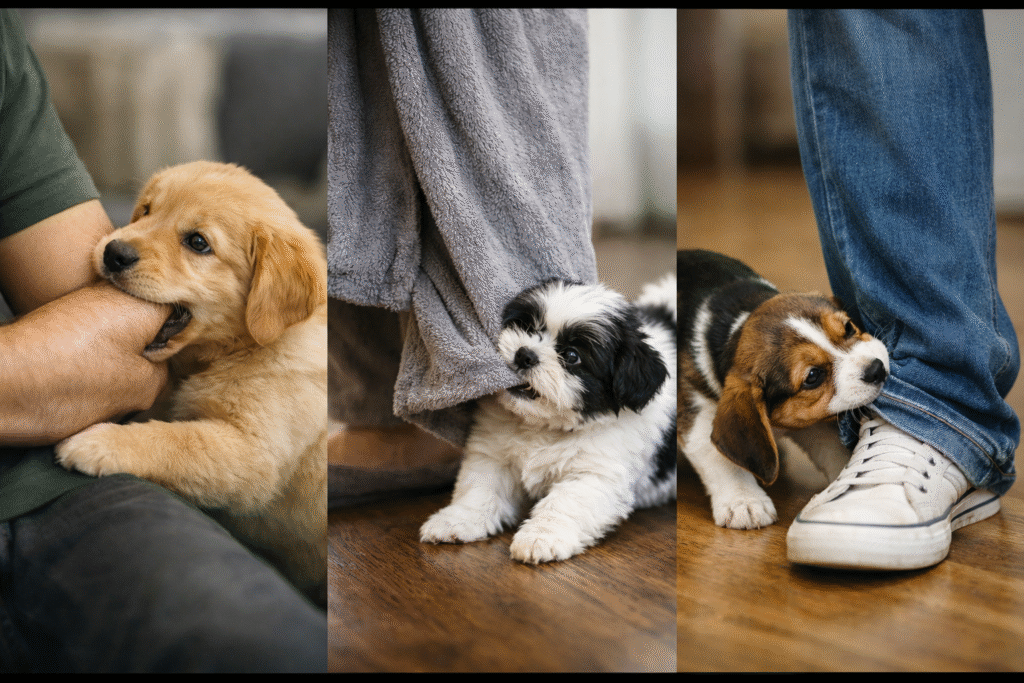
Read This First (seriously)
Puppies play bite because they must receive feedback for their bite pressure so they can acquire the skill of monitoring and adjusting the force of their jaws.
That process is what develops
Acquired Bite Inhibition (ABI).
Good ABI is what makes a safe dog in adulthood.
This can only be done in the early stages before it’s locked in forever.
Bottom line
You don’t want to “stop puppy biting”… because then the bite training stops too.
We’re training force first.
The Master Key
Intensity before frequency.
In the correct progression you’ll see a reduction in force before you see fewer incidents.
Biting gets softer and softer before actual biting diminishes.
Force has a time limit. Frequency does not.
Translation: stop counting bites. Start measuring pressure.
Age Limits (don’t ignore this)
By about 18 weeks, brain chemistry starts changing and your window for ABI starts closing.
By six months, it’s pretty much closed.
If you have an 8–9 month old dog grabbing sleeves/arms and you skipped this… you’ll need a different plan.
Why “OUCH” Must Be Loud (and sharp)
Puppies already learn some inhibition with littermates: one bites too hard, the other yelps, the game ends.
Puppies yelp loud. Humans do it softly. That’s why it doesn’t work for most people.
Your puppy has tougher skin and a fur coat. You have… not that.
So we teach: even slight pressure ends the game.
A long drawn-out “nooooo” does nothing.
We need a clean pattern interrupt: OUCH → head pulls back → we reward softer re-engagement.
The 4 Fixes (try these in order)
This isn’t a quick fix. This is reps.
Your puppy is going to try to play with you. Some are persistent. Some switch faster.
This doesn’t mean your puppy is mean. It means they’re a puppy.
1) OUCH (Sharp) + Freeze
Say “OUCH!” loud and sharp enough to interrupt the pattern.
The puppy’s head should pull back.
Rule: DO NOT jerk your hand away. Quick movement triggers prey drive and they’ll go harder.
Leave it there. Let the puppy be the one to back off.
The instant they’re softer? Praise and re-engage.
2) Redirect (instantly)
If you redirect, replace your hand with a toy immediately.
Not “hold on.” Not “let me find it.”
Playful puppies must put something in their mouths — make it a toy, not your wrist.
3) Leash Play (optional, wildly helpful)
Keep puppy on a leash while you play.
Step on the leash about 12 inches from the collar (adjust by size) so they can’t launch and bite.
Wait for calm. Then re-engage.
4) Social Feedback (dogs do it 50x faster)
Dogs give better bite feedback than humans.
Get your puppy into a well-run play group / class as soon as your vet clears it (often after the 2nd shots).
No dog parks. We want controlled exposure, not chaos with fur.
Bail Out If It’s Too Much
If puppy is too jazzed up and not responding, don’t “timeout” the puppy like it’s a toddler.
That’s too slow and non-instructive.
You leave. 30–60 seconds. Come back. Try again.
If they bite hard again, you leave again.
Important: We do not label puppy biting “bad.” It’s inconvenient — not evil.
Statue Mode (the tree method)
Make a loud yip/OUCH in the moment…
Then
freeze. Fold your arms across your chest.
You are now a tree. Your branches are closed.
No words. No eye contact. Turn away. Don’t move.
You’re furniture. Expensive, silent furniture.
Climb the Ladder
As you work, you should see the ABI progression: bites get softer over weeks.
When play biting becomes soft mouthing, then it’s appropriate to address frequency.
At that point, we use incompatible behaviors (place, sit, leash calm), redirecting, impulse control,
and instructive play.
Tools That Help
Chew toys for quiet time: relaxing, self-occupying.
Gentle tug (with rules): manners + impulse control.
Food handling: don’t get face-to-face in the bite zone.
Don’t Set Yourself Up
Don’t jerk hands away (prey drive)
Don’t sit on the floor for long play sessions
Don’t put face/beard/hair in the bite zone
Don’t scold nature — train it
Mythbusting (aka: “Please stop taking training advice from comments sections.”)
Common “Fixes” That Miss the Point
Leave It / Drop It: great skills… not ABI training.
“No bite!” only works if trained separately first.
Chew toy redirection: management tool, not the whole plan.
Hard No’s (don’t do these)
Tapping nose / grabbing muzzle (hello, head-shy dog)
Thumb in mouth / tongue smash (abuse, not training)
Squirt bottles (stop it)
Muzzles for mouthy puppies (kills mouth learning)
Normal vs Concerning
Normal play includes chasing, pouncing, barking, growling, snapping, biting. Concerning signs:
prolonged deep growling, fixed stare, stiff posture, or “not playful” intensity.
If you see that — text/email us and we’ll adjust.
Kids + Safety
Kids under 8–9 can’t reliably do behavior modification.
Their first reaction is usually to push the puppy away — which the puppy reads as play.
Rule: if puppy is loose, an adult is responsible. If not supervised, puppy is in structure.
Goal: Protect the dog and you’ll be protecting the kids.