Puppy Basics
Some puppies don’t struggle because they’re stubborn. They struggle because everything is brand new and humans tend to explain things like they’re reading instructions to a blender. Sit gets repeated five times. Recall gets used only when the fun is over. Stay gets rushed. Drop It turns into a wrestling match. Then everyone acts confused about why the puppy looks confused.
That doesn’t mean your puppy is difficult. It means the basics need to be taught clearly, cleanly, and in the right order. This page is here to help you build a handful of useful behaviors that actually matter in real life — emergency recall, sit, down, basic stay, the marker word YES, and Drop It — without turning training into a fog machine.
⚠️ Quick Truth Before You Start
If the rep looks messy, the answer is usually not “say it louder” or “do more.” It is almost always: make it easier, clean up the picture, and fix your timing.
First 7 Days (Keep It Small, Keep It Clean)
This is not about cramming six skills into one overachieving afternoon. Your first week is about short reps, clean pictures, and not teaching your puppy to ignore you by accident.
Days 1–2
Marker word + sit. Teach YES, catch offered sits, and start building the idea that paying attention to you is profitable.
Days 3–4
Recall + down. Keep it indoors, short, upbeat, and clear. Do not poison recall by only using it when the party is over.
Days 5–7
Basic stay + Drop It. Tiny duration, tiny wins, and lots of trading up so the puppy learns release without drama.
What This Is / Why This Matters
This is not a race to collect commands. This is a system for building a few useful behaviors the right way so your puppy starts understanding what the heck you mean.
What This Is
- A guided basics page for a small handful of real-life skills.
- A way to build cleaner communication without overspeaking or overcomplicating the reps.
- A chapter you can return to after we’ve already talked through the picture.
Why It Matters
- Most puppy training gets muddy fast because people rush the basics.
- Too many words, repeated cues, and bad timing create confusion.
- One clean cue, one clean picture, one clean mark, one reward — that is where understanding starts.
The Order That Works
You do not need to teach everything at once. You need the right order: marker → attention → sit/down → recall → basic stay → Drop It.
1. Teach the Marker Word
YES is the bridge. It tells the puppy exactly what paid.
2. Build Simple Positions
Sit and down teach body control, focus, and the idea that calm behavior creates the paycheck.
3. Teach Recall Early
Come matters because life happens fast. Recall should mean “run to me for good things,” not “fun is over.”
4. Add Stay + Drop It
Tiny duration, tiny wins, and clean release mechanics. No drama. No wrestling matches.
How to Run It in Real Life (Click to Open)
Don’t skim this. This is the “how.” Open one section, read it fully, then go run clean reps. One picture at a time. That’s how dogs actually learn.
The Marker Word YES — The Bridge Word
YES is the bridge between the behavior and the reward. It tells your puppy exactly what paid so you are not racing the treat and hoping they connect the dots.
Why It Works
Without a marker word, you are late more often than you think. YES buys you a little space and makes the message cleaner.
Timing Rule
You have about half a second to say YES after the correct behavior happens. Not eventually. Right then.
Emergency Recall — Come, Come, Come
This is your emergency command. It is not the same as casual recall. This is the one you use when you need your puppy moving toward you right now, fast, and with real intention.
How to Start
- Use two people if possible.
- Start indoors with about 15 feet between you.
- As the puppy improves, build to 25 feet, then 50 feet.
- Keep it fun, fast, and upbeat.
The Core Pattern
- Say the puppy’s name one time to get attention.
- Then say COME, COME, COME in an excited, urgent tone.
- Keep repeating it until the puppy’s nose reaches your hand target.
- The instant they arrive: YES and pay well.
What Makes It Work
This command needs energy. It should sound different from your normal daily voice. You want the puppy thinking, “Oh, this matters. I better move.”
What to Use for Payment
Use high-value food only. Cut-up grass-fed beef hot dog, cheese, rotisserie chicken, freeze-dried liver — something your puppy really cares about.
Sit — One Word, Clean Picture
Sit should be simple. Say Sit once, then mark the exact moment the butt hits the floor.
Do This
- Use the cue once.
- Mark the butt hitting the floor with YES.
- Capture offered sits too — smart dogs repeat what works.
Also Do This
Practice your hand signal in the mirror first so you don’t accidentally invent interpretive dance in front of the dog.
Down — Slow Lure, Clear Picture
Down is a slower picture for a lot of puppies, so this one needs patience. Slow lure. Clear picture. Good timing.
How to Start
- If possible, begin with the puppy in a sit.
- Put the treat at the nose like a magnet.
- Say Down one time only.
- Guide the treat slowly down between the front paws.
The L-Pattern
Once the treat moves down between the paws, bring it slightly forward so the puppy follows it with their nose and body until the belly touches the ground.
The Mark
The instant the belly hits the floor, say YES and reward. That exact timing is what teaches the picture.
If You Have Help
A helper can hold the puppy more steadily while you guide with the lure. Cleaner mechanics usually make this much easier.
Basic Stay — Tiny Duration, Clean Wins
Stay is not about showing off. It is about teaching stillness in small, clean layers so your dog learns how to hold position without you turning into a broken speaker.
How to Start
- Face your dog and ask for a sit.
- The moment the butt hits the ground, say YES and give a treat.
- Then say STAY in a soft calm tone one time only.
- Hold your hand out like a traffic cop so the picture is clear.
First Reps
- Wait about 3 seconds.
- Walk back to your dog while they are still holding the stay.
- When you get back to them, say YES and give a high-value treat.
- Then reset and repeat.
How to Build It
On the next rep, wait a little longer before returning to your dog. Walk all the way back to their side, say YES, and give another high-value treat.
Then say Break, Break! to release and walk away. Do not stare at your dog, and do not look back.
What to Increase
- A few more seconds
- A few more steps away
- Always return all the way back to your dog before rewarding
Drop It — The Release Game
Drop It matters in real life. Sock. Toy. Paper towel. Chicken bone. Random disgusting mystery object from the yard. This is the release command — and it needs to be taught cleanly.
Know the Difference
- Take it = permission to get it
- Leave it = do not touch it
- Drop it = release it now
Core Mechanics
- Use a very high-value treat at the nose.
- Say Drop it, drop it, drop it.
- The instant the object is released: YES.
- Then reward immediately.
Game 1 — Magnet Treat Swap
Present the treat right at the nose so your puppy naturally lets go of the object to investigate the better option. The instant the item drops: YES and reward.
Game 2 — Trade-Up Scatter
For puppies or dogs with more possession or guarding tendencies, toss a handful of food away from them while cueing Drop It. While they move to the food, safely retrieve the item.
Game 3 — Tug Release
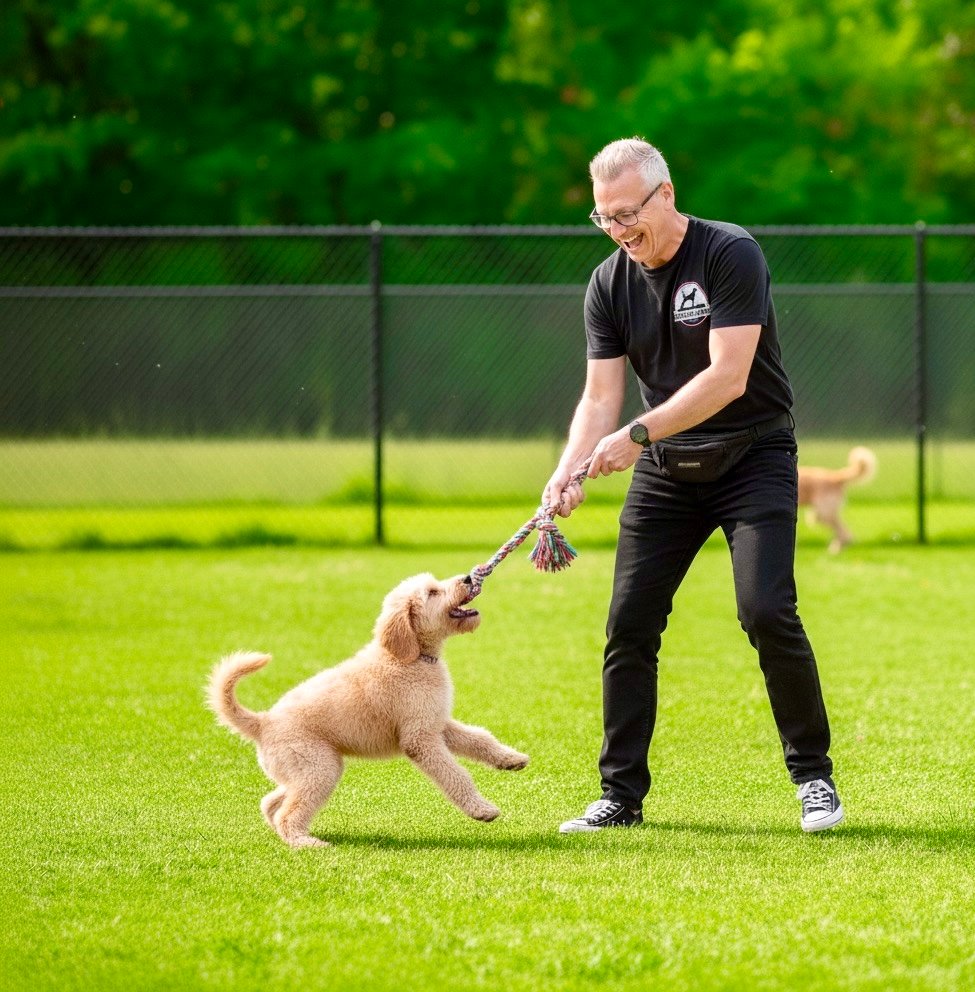
If you are playing tug, let the toy go dead. Say Drop it. When the puppy releases, say YES and restart the game. The game itself becomes part of the reward.
Game 4 — Two-Ball Game
Show the second ball, cue Drop it, mark the release, then throw the second ball. This works beautifully for dogs who love chase more than food.
Real-Life Use
Practice this before you need it. You do not want the first serious Drop It rep happening while your puppy has something dangerous in their mouth.
How to Think About It
Some dogs need more of a trade. Some need more of a game. Some need both. The point is to teach the release without turning it into conflict.
Common Mistakes (With Love)
Most training breakdowns are not because the puppy is difficult. They happen because the reps got muddy.
- Repeating the cue over and over.
- Marking late.
- Overtalking the rep.
- Rushing difficulty.
- Practicing too long.
- Turning Drop It into a wrestling match.
What to Expect / Quick Tracker / Quick Reminders
Progress usually looks like better timing, cleaner pictures, faster responses, and less confusion. Not perfection. Not magic. Just cleaner reps stacking over time.
What Progress Looks Like
The puppy responds faster, the picture looks cleaner, and you feel less like you’re making things up as you go.
What Progress Does Not Look Like
Perfection on day one. Every rep being magical. Or your puppy suddenly deciding they’re a college graduate.
Printable Quick Tracker
| Date | Skill | Could Puppy Do It? | Food Used | Notes |
|---|---|---|---|---|
| ____/____/____ | ____________ | ☐ Yes ☐ No | ____________ | ____________ |
| ____/____/____ | ____________ | ☐ Yes ☐ No | ____________ | ____________ |
| ____/____/____ | ____________ | ☐ Yes ☐ No | ____________ | ____________ |
| ____/____/____ | ____________ | ☐ Yes ☐ No | ____________ | ____________ |
| ____/____/____ | ____________ | ☐ Yes ☐ No | ____________ | ____________ |