
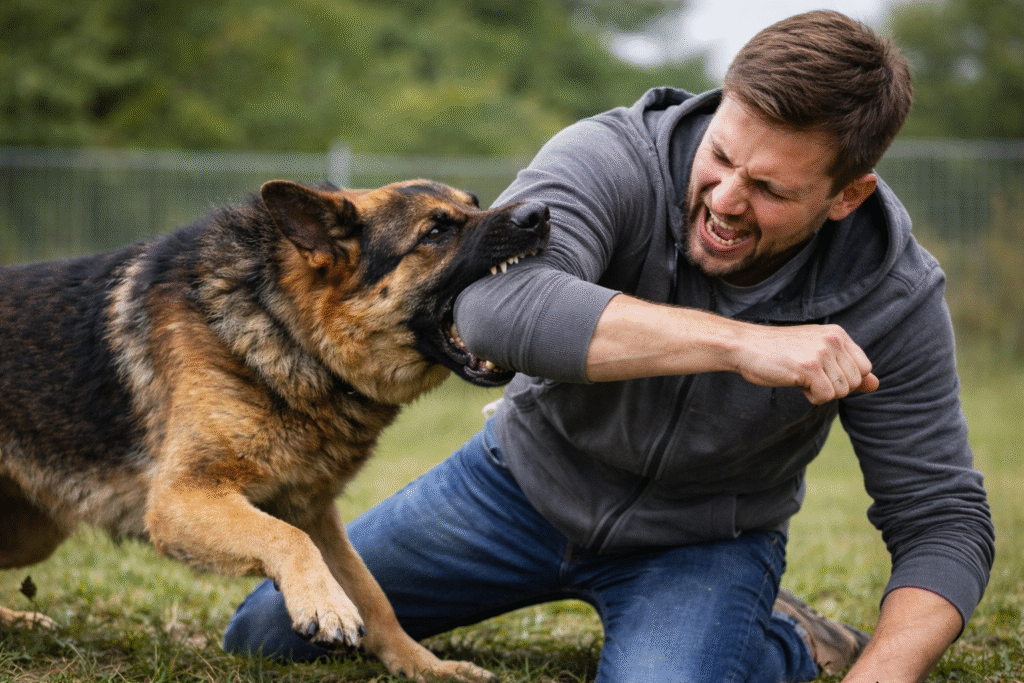
First, take a breath. A bite is serious, but it does not automatically mean your dog is hopeless.
It does mean the situation needs to be handled with honesty, structure, and a better plan than,
“Let’s just see what happens.”
A dog bite is not usually one random moment. It is often the end of a stress sequence:
pressure builds, warning signs get missed, the dog crosses threshold, and the nervous system chooses survival over manners.
After a bite, the worst move is often putting the dog right back into the same situation to see if everything is fine. That is not a plan. That is a rerun with better lighting — and nobody needs Bite Episode Two.
Most dogs do not bite out of nowhere. There is usually pressure, fear, pain, frustration, guarding, over-arousal, poor social skills, a bad setup, or a trigger that pushed the dog past threshold.
The bite is the moment everyone notices. But the dog’s body was usually talking before that. The problem is, dogs whisper before they yell — and humans often miss the whisper.
Do not put the dog right back into the same setup just to “see what happens.”
Use leashes, gates, doors, crates, and distance until there is a real plan.
The most important clues are usually found right before the bite.
Bite cases need calm investigation, not internet guessing and crossed fingers.
Open each section below. This is educational, but it is not the full treatment protocol. A dog with a bite history needs a plan built around the dog, the home, the trigger pattern, the humans involved, and the actual level of risk.
A bite is not “just bad behavior.” It is usually the end point of a nervous system event.
In plain English, the dog’s brain may be saying: “I am overwhelmed. I need distance. I need control. I need this threat to stop. I tried other signals and they did not work.”
And here is the dangerous part: biting worked. If the bite made the scary, irritating, painful, threatening, or overwhelming thing go away, the behavior may have been reinforced.
Dogs do not usually bite because they “want blood.” Most bite because the behavior solved a problem. That does not excuse the bite. It explains why we have to take the setup seriously.
Before the bite, the dog is often already in sympathetic nervous system arousal: heart rate rises, breathing changes, muscles tighten, pupils may dilate, digestion slows, adrenaline increases, cortisol begins rising, and the thinking brain gets quieter while the survival brain gets louder.
Adrenaline is the fast one. Cortisol is part of the longer stress response. After a serious bite, especially if there was chasing, screaming, restraint, punishment, injury, or multiple dogs involved, the dog may remain emotionally “hot” for hours or even days.
That does not mean cortisol stays high the entire time. It means the nervous system can stay sensitized. The dog may be more jumpy, more reactive, more guarded, more suspicious, more tired, or quicker to escalate.
This is why the first 24–72 hours after a serious bite should be treated like a decompression window. Not a boot camp. Not a courtroom. Not a family meeting where everybody stares at the dog like he just robbed a bank.
Most dogs are not sitting around plotting Bite Episode Two. But they may bite again if the same problem shows up and biting worked the first time.
So the real question is not, “Does my dog want to bite again?” The better question is: “What did the bite accomplish for the dog?”
That does not make the dog evil. It makes the dog educated by consequence. Dogs repeat behaviors that solve problems. That is learning, not morality.
Our job is to prevent rehearsals and teach safer ways to handle pressure before the dog reaches that point again.
Many dogs give warning signs before they bite. The problem is that people often miss them, explain them away, or accidentally punish them.
A growl is not the problem. A growl is information. It is the smoke alarm. If you punish the smoke alarm, you may still have the fire — now you just removed the warning system.
This is where good people accidentally make the problem worse. They rush. They test. They punish. They force the dog to prove everything is fine before anyone has actually figured out what happened.
After a bite, your job is not to win an argument with the dog. Your job is to prevent another rehearsal, lower the temperature, and figure out what caused the behavior in the first place.
The dog still needs rules, boundaries, and structure. Absolutely. But panic and punishment can remove warning signs without fixing the emotional state underneath. That is not safer. That is just quieter before the next problem.
A dog with a bite history usually needs a layered plan. Not one magic command. Not one YouTube trick. And definitely not “let’s just socialize him more.”
Before training, the dog needs a safety plan. That may mean leash control, crate or gate separation, no free access to triggers, no unsupervised dog-dog interaction, muzzle conditioning if there is real bite risk, clear household rules, and an honest written bite history.
Pain and aggression are roommates more often than people think. A dog may bite because of orthopedic pain, dental pain, ear infection, skin irritation, neurological issues, endocrine concerns, or general discomfort. Training matters, but pain needs to be ruled out.
The dog needs lower stress, predictable routine, sleep, distance from triggers, enrichment, sniff walks, and calm structure. You cannot build better behavior on top of a nervous system that is still on fire.
This is where training gets specific: desensitization, counter-conditioning, threshold work, response substitution, impulse control, marker training, leash handling, place/crate relaxation, owner timing, muzzle conditioning, controlled exposure, and replacement behaviors.
Most bite cases are not fixed by “training the dog” only. The human has to learn when to create distance, how to read stress signals, how not to punish warning signs, how not to tighten the leash and panic, how to stop rehearsals, and how to advocate before the dog has to.
Because after a bite, guessing gets expensive fast — emotionally, physically, legally, and relationally. This is not the time to collect 37 opinions from the internet and then try the loudest one.
A professional needs to look at the bite history, the environment, the setup, the dog’s body language, the human handling, the household rules, the trigger pattern, and the level of risk.
We also build a trigger map. Green means the dog can think, eat, respond, and recover. Yellow means the dog notices the trigger but can still work. Red means the dog is over threshold.
Do not wait for the next bite to get serious. A Bite Behavior Super Session gives you a calm place to start: safety, management, body language, trigger patterns, and the first layer of training your dog actually needs.