
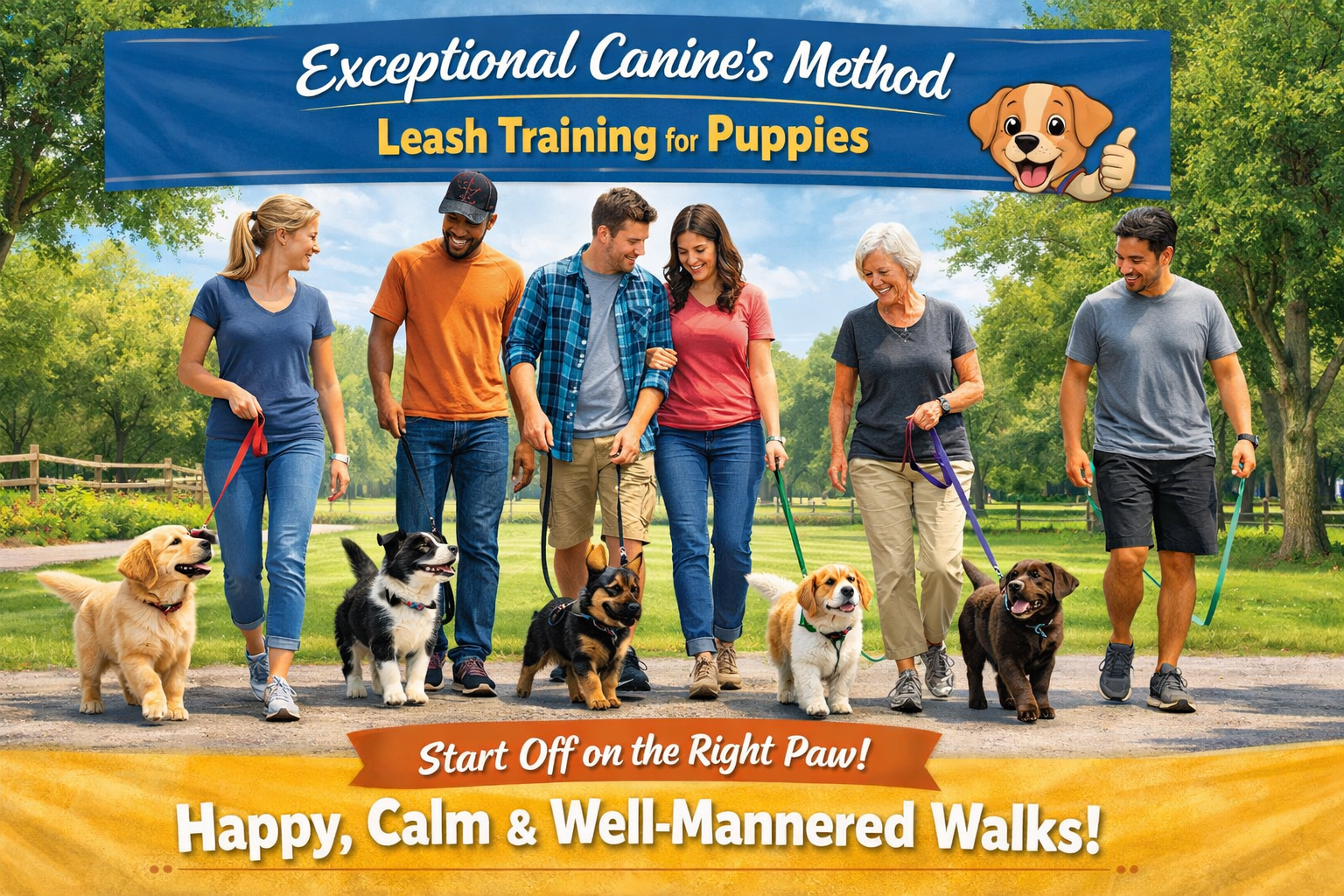
Some puppies don’t “go for a walk.” They treat the leash like it is either a snake, a toy, or a formal complaint against your leadership. They freeze. They bite the leash. They pull like tiny maniacs. They zig-zag like they’re late for six appointments.
That doesn’t mean your puppy is bad. It means leash manners are not natural for dogs, and somebody has to teach the picture clearly. This page is here to help you build that picture the right way — with short reps, smart progression, clean structure, and enough patience not to turn every walk into a neighborhood negotiation.
If your puppy cannot stay connected to you inside, in the yard, or at the doorway, the sidewalk is not the next step. Going to a harder environment too soon does not make training more impressive. It usually just makes it messier.
Puppies do not come with leash manners pre-installed. They come with curiosity, feelings, opinions, and a strong desire to investigate every blade of grass like it might hold state secrets. So your first week is not about “perfect walking.” It is about setting the picture.
Leash = good things. Light leash indoors, supervised. Food, play, and calm reps happen while the leash exists. Zero pressure.
Follow-Me game. Move away, puppy catches up, YES + reward. This builds engagement before you ask for structure.
Doorways + tiny leash reps. Sit at thresholds, you go first, leash reps stay short, and slack leash moments get paid.
This is not about creating a polished competition heel on a baby dog. This is about teaching your puppy how to move with you, how to stay connected, how to handle leash pressure without drama, and how to understand that the walk has structure.
When you strip away internet noise, good leash training follows a pattern: condition the leash → build engagement → teach threshold patience → practice slack leash walking → add distractions later.
Leash shows up. Good things happen. Puppy stays normal. We are not “walking” yet.
Before formal walking, teach your puppy to notice you, choose you, and catch up to you.
Door opens on calm behavior. The sidewalk does not begin with a launch sequence.
Tight leash = stop. Slack leash + check-in = YES + move. Sniff breaks can be the paycheck.
Don’t skim this. This is the “how.” The dropdowns below are written to be followed in order so the picture stays clean and your puppy does not end up trying to negotiate every rep like a tiny union boss.
Puppies are still developing. Neck, trachea, nervous system, confidence, frustration tolerance — the whole thing is still under construction. So under about 6 months, your goal is foundation and confidence, not forcing a polished walk.
Protect the puppy. Reset. Drop the difficulty. A confident puppy becomes a calmer adolescent. A stressed puppy becomes a project.
Tools support training. They do not replace training.
Martingales are limited-slip collars. They tighten to a safe limit and help prevent the “my puppy slipped the collar” heart attack. They are not choke collars. They are not punishment tools. They are seatbelts with feedback.
Puppies often do best with snap martingales because they are practical and easier for daily use. Older dogs may do well with hand-adjustable martingales for a more dialed fit.
Before the leash means walking practice, the leash should mean good things. This keeps you from creating leash stress before your puppy even knows what the leash is for.
No tugging, dragging, or “come on!” while your puppy is overwhelmed. That’s how you create leash stress and outside fear.
Heel is advanced. Engagement is foundational. We teach your puppy to choose you before we ask for manners outside.
2–5 minutes. Quit while it is fun. Do not wait for your puppy to file a workplace complaint.
Doorways are free leadership lessons. If your puppy cannot pause at the door, the sidewalk is going to feel like Times Square with squirrels.
About 5–10 reps. Not 47. We are building a habit, not writing a novel.
Puppies sniff. Puppies explore. We are not erasing curiosity. We are structuring it.
Pulling is self-rewarding. If it works today, it will be stronger tomorrow. We make pulling boring and connection profitable without turning you into a grumpy tow truck.
Adolescence is when your puppy becomes a teenager with legs. The rules do not change. Your consistency does.
If you recognize yourself in here, relax. You are not failing. You are learning the skill too.
Progress usually looks like cleaner starts, less leash biting, better engagement, calmer doorway behavior, and more moments where the leash has actual slack instead of looking like you’re flying a kite.
The puppy recovers faster, checks in more, and needs less micromanaging.
It does not look like a perfect heel overnight. It looks like cleaner reps stacking over time.
| Date | Skill / Phase | Environment | Could Puppy Stay Connected? | Food Used | Notes |
|---|---|---|---|---|---|
| ____/____/____ | ____________ | ____________ | ☐ Yes ☐ No | ____________ | ____________ |
| ____/____/____ | ____________ | ____________ | ☐ Yes ☐ No | ____________ | ____________ |
| ____/____/____ | ____________ | ____________ | ☐ Yes ☐ No | ____________ | ____________ |
| ____/____/____ | ____________ | ____________ | ☐ Yes ☐ No | ____________ | ____________ |
| ____/____/____ | ____________ | ____________ | ☐ Yes ☐ No | ____________ | ____________ |

Best results: buy tools to support the plan — not to replace the plan. If you’re not sure what to grab, text me a screenshot and I’ll tell you “yes / no / not yet.”