
This is where the real-life puppy stuff lives — the rules, rhythms, exposures, and household decisions that make everything else easier. Not more complicated. Not more dramatic. Just clearer.
Most puppy problems are not mysterious. They usually come from unclear rhythm, too much freedom too fast, or humans trying to do the right thing at the wrong time.
You are not supposed to read everything at once. Open the section that matches what you need today, run it clean, then close the page and go live your life.
Start with Section 1.
Start with Section 2.
Start with Section 3.
You may want to read this first. If your dog could talk back, this is the section that would save both of you a lot of confusion. Tonal, visual, spatial — then the daily habits that turn a decent dog into an Exceptional Canine.
Your dog is listening to your tone, watching your body, and reading the pressure you create in space. So if your words say one thing but your posture, timing, or energy say another… your dog usually believes the body first as you witnessed when I was there remember?
This page gives you the communication basics first, then the top daily training habits that help behaviors actually stick in real life.
Dogs learn best when the message is simple, the timing is clean, and the household is not freelancing with six different words and three different structures for your dog or puppy for the same command or request.
Clear Cue → Clear Marker Word Timing → Clear HIGH Reward → Daily Reps → Reliable Dog
This is not about running a dog boot camp in your kitchen. It is about short, repeatable reps that make the behavior stronger and the dog clearer.
When you combine clean communication with consistency and care, training stops feeling like drilling commands and starts feeling like building a relationship your dog can actually understand.
| Date | Behavior / Cue | Treat Used | Used YES On Time? | Session Length | Notes / Tiny Win |
|---|---|---|---|---|---|
| ____ | ________________ | ________________ | Yes / No | 3–5 min / Other | ________________ |
| ____ | ________________ | ________________ | Yes / No | 3–5 min / Other | ________________ |
| ____ | ________________ | ________________ | Yes / No | 3–5 min / Other | ________________ |
| ____ | ________________ | ________________ | Yes / No | 3–5 min / Other | ________________ |
Keep it short, keep it daily, keep it clear, and keep it consistent. That is how dogs stop guessing, owners stop repeating themselves, and households start feeling a whole lot saner.
You may want to read this Second! This is the kind of real conversation we’d probably be having around 7:30 at your kitchen table — the stuff good people do with good intentions that quietly creates confused dogs.
Not because they do not care. Not because their dog is bad. Usually because nobody ever explained the small everyday things that quietly delay progress, muddy communication, or teach the wrong lesson.
So instead of some fluffy top-10 list, this is a straight look at the most common ways owners accidentally make life harder than it needs to be — and how to clean it up.
We are going to look at what causes confusion, why it matters, where it shows up in real life, what to do instead, and how to tell when the system is still too muddy.
Dogs do not need more drama, more yelling, or more gadgets. They need clearer owners(think student teacher relationship here) and a day that makes sense.
Confusion → Stress → Messy Behavior → Clearer System → Exceptional Dog
Most of what doggie parents think works with dogs either delays progress or quietly makes things worse. This page is here to help you spot the hidden stuff that looks harmless, feels normal, or even sounds “right,” but actually creates stress, inconsistency, or confusion.
So instead of pretending your dog is stubborn, dramatic, or trying to make you lose your mind before dinner, we clean up your role to a student teacher relationship first and watch what changes.
That is usually where real progress begins.Yes dog mom and dog dad later or after class.
You usually see this when:
It often sounds like: “He knows better,” “She’s doing it on purpose,” “Nothing is working,” or “He’s stubborn.” Most of the time, the dog is not being dramatic. The system is just too muddy for the dog to win consistently.
Most of what we work on is not about tricks. It is about clarity, consistency, leadership without emotion, and structure that the dog can actually understand and live inside every day.
If your house has felt a little like a crime scene lately, good. That means we found the mess. Now we clean it up one small change at a time, one consistent day at a time.
| What I’m Seeing | What Might Be Causing It | One Change I’m Making | Date / Notes |
|---|---|---|---|
| ________________ | ________________ | ________________ | ________________ |
| ________________ | ________________ | ________________ | ________________ |
| ________________ | ________________ | ________________ | ________________ |
| ________________ | ________________ | ________________ | ________________ |
Clean up the human side, simplify the rules, make the day make sense, and your dog usually gets a whole lot easier to live with.
Short. Clear. Repeatable. This is where consistency replaces guessing and your dog actually starts learning.
A training session is a short, focused block of time where you work on ONE skill. Not five. Not ten. One.
Dogs don’t learn from random moments. They learn from repeated, clear patterns.
If this gets sloppy, you start training too long, too vaguely, and with too many moving parts.
Short sessions. Clean reps. Consistent days. That’s how dogs actually learn.
Pick One Skill → Ask Once → YES → Reward → Repeat → End on a Win
A short, focused block of time where you work on ONE skill. Not five. Not ten. One.
Dogs don’t learn from random moments. They learn from repeated, clear patterns.
When to Train
Where to Start
Start in a quiet space. No distractions. Then slowly build difficulty. Living room → backyard → real world.
| Day | Skill | Minutes | Win? |
|---|---|---|---|
| Mon | |||
| Tue | |||
| Wed |
Short sessions. Clean reps. Consistent days. That’s how dogs actually learn.
How our human quirks can drive dogs barking mad.
Humans and dogs are not reading the same social manual. We walk up, stare, reach, lean, move fast, and act in ways that often make dogs uncomfortable. This section helps people understand what we do that can make dogs uneasy, and what to do instead.
If we want to get along with our furry buddies, we should be a little less “us” and a lot more “them.”
If this gets sloppy, people accidentally become the pressure instead of the help.
Less pressure, less drama, more space, more calm, and better timing.
Slow Down → Give Space → Let the Dog Read You → Let the Dog Choose
When humans act all human-like and approach dogs, we often give them the heebie-jeebies. We strut up, offer handshakes, make eye contact, and close distance quickly. Most dogs are not looking for a business meeting. They are just being dogs, and our antics can feel intimidating.
Kids can be especially hard for dogs to read because they move fast, act unpredictably, and often make dogs feel like they are watching a surprise twist in a telenovela.
Imagine you’re teaching your dog that making eye contact is like winning the lottery — and you want them to be the biggest jackpot winners. Start with family, the ones your dog already trusts, and train them to make eye contact a hoot.
But dogs don’t dig staring contests. So when you lock eyes with a dog you don’t know well, be like the cool kid who knows when to break the gaze. Soften your peepers and give your dog some space to breathe.
When other humans try to muscle into your dog’s personal space with their weird handshakes and intense eye contact, step in. Create that buffer with your body between them and your pooch, or teach your dog to take shelter behind you or go to his or her place and stay.
Think of the 5 Minute Rule here.
Show your furball that these newcomers aren’t dangerous by keeping your cool and keeping them on the leash, go with the flow.
Don’t shove your mitt in their face — it’s rude in any language. Dogs can smell you just fine without you invading their personal space. If they want to be buddies, they’ll let you know.
Oh, the classic head pat. It feels universal to us, but most dogs find it overwhelming. Start under the chin, then move on to the body — if your dog gives the green light. Let them decide the petting menu.
And as for hugs, humans are all about it, but it’s a foreign concept for dogs. Some tolerate it, some love it from trusted humans, and some dodge it like a ninja. Don’t force it, and definitely don’t let strangers, especially kids, go all octopus on your dog.
Fast and jerky movements are a no-go. If you’ve got the jitters, you’re setting the stage for a canine drama. Slow and steady, like a sloth on a mission — that’s the way to go.
Kids, take note: chill out around dogs. The less you move like a squirrel on caffeine, the happier our furry friends will be.
Your mood is like a megaphone to your dog. Even if you are secretly panicking about your dog meeting another dog or facing a squad of rowdy kids, keep your cool.
Distance is your dog’s guardian angel. Steer clear when in doubt, and use treats and praise to teach your dog that new stuff is NBD.
The calmer you are, the calmer your dog will be — it’s like a Jedi mind trick, but for dogs.
| Date | Situation | What Human Did | Dog Stayed Calmer? | Used More Space? | Notes |
|---|---|---|---|---|---|
| ____ | Guest / Kid / Walk / Other | ________________ | Yes / No | Yes / No | ________________ |
| ____ | Guest / Kid / Walk / Other | ________________ | Yes / No | Yes / No | ________________ |
| ____ | Guest / Kid / Walk / Other | ________________ | Yes / No | Yes / No | ________________ |
| ____ | Guest / Kid / Walk / Other | ________________ | Yes / No | Yes / No | ________________ |
We’re a bunch of aliens in the world of dogs, but that doesn’t mean we can’t get along. When in doubt, be a dog’s best friend by speaking their language: less pressure, less drama, more space, more calm, and better timing.
Short. Clear. Repeatable. This is where consistency replaces guessing and your dog actually starts learning.
A training session is a short, focused block of time where you work on ONE skill. Not five. Not ten. One.
Dogs don’t learn from random moments. They learn from repeated, clear patterns.
If this gets sloppy, you start training too long, too vaguely, and with too many moving parts.
Short sessions. Clean reps. Consistent days. That’s how dogs actually learn.
Pick One Skill → Ask Once → YES → Reward → Repeat → End on a Win
A short, focused block of time where you work on ONE skill. Not five. Not ten. One.
Dogs don’t learn from random moments. They learn from repeated, clear patterns.
When to Train
Where to Start
Start in a quiet space. No distractions. Then slowly build difficulty. Living room → backyard → real world.
| Day | Skill | Minutes | Win? |
|---|---|---|---|
| Mon | |||
| Tue | |||
| Wed |
Short sessions. Clean reps. Consistent days. That’s how dogs actually learn.
Calm arrivals. Calm departures. Calm transitions. This rule helps lower arousal, reduce clingy patterns, and stop the doorway from turning into an emotional event every time somebody comes or goes.
Emotionally overwhelming your dog during arrivals and departures benefits no one. Dogs do not need you acting like you just won the lottery or escaped from Alcatraz.
Calm in. Calm out. Calm transitions. That is the picture we are building.
If this gets sloppy, the doorway becomes an emotional event instead of just a doorway.
You choose when interaction starts—not the dog’s frantic energy.
Come In Calm → Wait 5 Minutes → Invite Dog Over Later
Imagine your dog’s thoughts: “Is the world ending out there? Look at her… she’s behaving like she may never return.”
Big emotional entrances and exits do not make your dog feel more loved. They raise arousal, increase anticipation, and can contribute to jumping, whining, pacing, chewing, clinginess, and separation issues.
When you, your family, or anyone else returns home, open the door, greet your dog with a quiet, loving hello if you must, and then carry on with your lives for at least 5 minutes — or longer if needed.
Yes, it may sound a little cold at first, but think about it: do you greet your loved ones with a Broadway performance every single time you walk through the door?
A brief eye contact, a soft smile, and a warm, calm voice are more than enough. If you have more than one dog, acknowledge each one in the same calm, non-dramatic way.
Do not leave the house like it is the end of the world. Most dog professionals agree that your emotional state during departures matters. If you are anxious, apologetic, and dramatic, your dog is far more likely to think, “Well now I’m worried too.”
This does not mean becoming a cold, heartless dog parent. It means learning the difference between warmth and emotional tornado energy. You can absolutely be loving without staging a full-blown production at every entrance and exit.
Once you’ve settled in from your day, you can invite your dog over calmly. That might be after 5 minutes, 10 minutes, or 20 minutes. The point is that you are choosing the timing — not the dog’s frantic energy.
Calm invitation. Calm interaction. Much cleaner picture.
If you have been away for a while and your dog or puppy urgently needs to go out, leash up, handle the potty break, and then begin your 5-minute cool-down. Pee takes priority.
Make sure everyone understands the drill. No fanfare during arrivals and departures. This only works when the pattern stays consistent across the household — and that includes guests.
| Date | Arrival or Departure | Stayed Calm? | Waited 5 Minutes? | Family / Guests Followed It? | Notes |
|---|---|---|---|---|---|
| ____ | Arrival / Departure | Yes / No | Yes / No | Yes / No | ________________ |
| ____ | Arrival / Departure | Yes / No | Yes / No | Yes / No | ________________ |
| ____ | Arrival / Departure | Yes / No | Yes / No | Yes / No | ________________ |
| ____ | Arrival / Departure | Yes / No | Yes / No | Yes / No | ________________ |
Calm in. Calm out. Your dog does not need theatrics. Your dog needs steadiness, predictability, and a home rhythm that does not spike their nervous system every time somebody touches a doorknob.
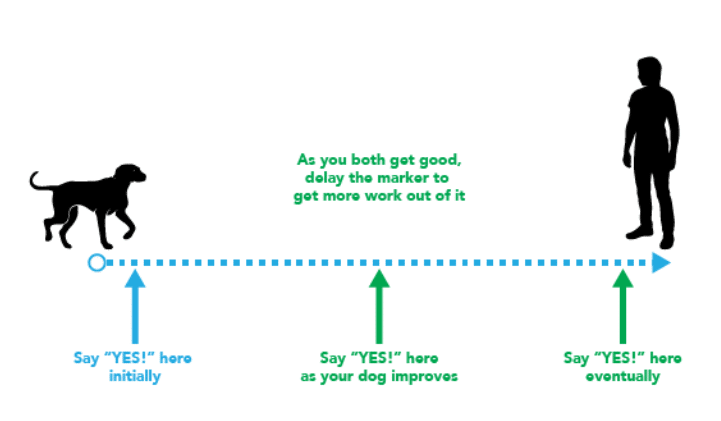
This is one of the most important things we worked on in your Super Session. “YES” is not praise. It is information. It tells your dog, clearly and instantly, “That right there… do that again.”
The marker word “YES” is one of the clearest ways to tell your dog they got it right. It is not emotion. It is not praise. It is a precise marker that bridges the correct behavior to the reward.
When your timing is clean, your dog learns faster. When your timing is late, your dog starts guessing.
If this gets sloppy, your dog stops hearing information and starts hearing noise.
“YES” is the bridge. It marks the exact moment your dog got it right and connects that moment to the reward.
Cue → Behavior → YES → Reward
“YES” tells your dog the exact moment they got it right. It doesn’t mean “good dog” in some vague emotional way. It means, very clearly, “That right there is what pays.”
That’s why this marker word matters so much. It removes guesswork and speeds up learning.
You have about half a second.
Sit → butt hits ground → YES → reward
Down → elbows or belly touch → YES → reward
If your timing is late, you reinforce the wrong thing. That is where confusion starts.
Say “YES” once. Not five times. Not louder. Not dramatically.
Then immediately deliver the reward.
YES must always predict something good. If that connection gets muddy, the marker starts losing value.
Better reward = better focus = faster learning.
Find your dog’s version of crack food. Kibble has a place, but when you’re teaching something important, value matters.
Phase 1 → heavy use of food and markers. Dog learns, “That word means I got it right.”
Phase 2 → food becomes less predictable. Dog learns, “I still have to respond.”
Phase 3 → real-life distractions, movement, environments. Dog learns, “I can do this anywhere.”
If your dog seems confused, it’s almost always timing or consistency.
| Date | Behavior / Cue Worked On | Did I Mark On Time? | Reward Used | Notes |
|---|---|---|---|---|
| ____ | ________________ | Yes / No | ________________ | ________________ |
| ____ | ________________ | Yes / No | ________________ | ________________ |
| ____ | ________________ | Yes / No | ________________ | ________________ |
| ____ | ________________ | Yes / No | ________________ | ________________ |
YES is one of the fastest ways to clean up communication. Mark the exact moment, reward it, repeat it often, and your dog will start understanding what pays.
Also known as the Deference Protocol and No Free Lunch. This is one of the biggest relationship reset tools in the whole system. Calm cooperation earns access, and structure starts replacing entitlement.
When nothing in life is free, manners become second nature. This is not about being harsh. It is about creating clarity, leadership, and a healthier relationship.
Calm cooperation earns access, and structure starts replacing entitlement.
If this gets sloppy, the dog starts learning that pushy behavior still works.
Good things come through you—not by default. The dog earns access to what it wants instead of demanding it.
Dog Wants Something → Ask for Sit → Yes → Reward / Access
Does your dog…
You’re not alone. These behaviors are more common than people think—and they often reflect not just the dog’s habits, but the owner’s approach.
We’ve all heard it: treat your dog like a person, and they’ll treat you like a dog. Love and affection absolutely matter, but spoiling your dog can lead to confusion, entitlement, and pushy behavior.
And while some issues may be rooted in genetics, the good news is this: the solution is often the same either way.
Also known as Nothing in Life Is Free (NILIF), this simple but powerful method teaches your dog that good things come through you—not by default.
The rule: your dog must earn access to rewards—food, toys, walks, playtime, petting, and even your attention.
How? By performing a basic behavior like Sit before receiving anything.
Stay calm and consistent. This is not about punishment or frustration. No yelling. No drama. Just clear communication and leadership.
Dogs should never be the ones initiating interaction. That role belongs to you.
When you return home, ignore your dog for the first few minutes. Then you call them to greet. If they drop a ball at your feet, ignore it. Later, you initiate play.
Why? Because when dogs constantly dictate interaction, they start believing they run the show. Rude behavior like barking, jumping, toy-guarding, and growling often comes from blurred leadership lines.
Mark the behavior clearly with a “Yes!” before delivering the reward—which is a high value treat, if you don't have a treat, then give some love, but silently... No good boy or good girl here. The love or the treat IS the reward. Remember Student/Teacher relationship
Leadership creates peace.
In homes where dogs are taught to defer to their humans, you tend to see calmer, more respectful behavior. These dogs are not perfect—but they are looking to their owners for guidance.
In contrast, dogs who run the house help themselves to food, toys, and attention—and often become rude, mouthy, and hard to live with.
| Date | What the Dog Wanted | What I Asked For | Dog Did It? | Family Consistent? | Notes |
|---|---|---|---|---|---|
| ____ | ________________ | Sit / Wait / Ignore | Yes / No | Yes / No | ________________ |
| ____ | ________________ | Sit / Wait / Ignore | Yes / No | Yes / No | ________________ |
| ____ | ________________ | Sit / Wait / Ignore | Yes / No | Yes / No | ________________ |
| ____ | ________________ | Sit / Wait / Ignore | Yes / No | Yes / No | ________________ |
With patience and consistency, you’ll be amazed how quickly your dog can transform. Because when nothing in life is free, manners start becoming part of everyday life.
Casual compliments are sweet, but during training they are too vague to be useful. Clear communication beats fuzzy praise every time.
“Good boy” and “good girl” are fine for affection after training, but during class they are too vague. Dogs learn faster when the feedback is precise.
The point here is not to become cold. The point is to become clear.
If this gets sloppy, your dog hears noise instead of information.
During training, precision beats praise. “YES” tells the dog exactly what earned the reward.
Cue → Behavior → YES → Reward → Affection Later
Let’s face it, dog owners aren’t the only ones who casually toss out phrases like “Good boy!” or “Good girl!” during quality time with their pets. Even kids get in on the action, because, well, it’s just instinct.
We want our four-legged friends to know we love them, approve of their shenanigans, and secretly wish they’d become canine geniuses overnight.
However, there’s a tiny problem with this approach. It’s vague, and when it comes to actual training, it’s about as useful as a broken squeaky toy.
Science has shown us that dogs can master up to 150 words — some even more. So if your dog’s vocabulary is like a library, your communication and relationship can be nothing short of bestselling.
“Good dog,” “good girl,” and “good boy” are about as clear as a foggy day in San Francisco for your pup.
The key is to get specific and attach the magical word “YES” to their behavior. Think of it as their golden star sticker.
For instance, when teaching or reinforcing the sit command, say “YES” the very moment their derrière hits the ground. Not a millisecond before, not a nanosecond after — right on the money.
Now, I know you’re sitting there thinking, “Ingo, can I ever say ‘Good Girl’ or ‘Good Boy’?”
Brace yourself, because the answer is an unexpected “yes” — but there’s a catch.
You can break out the casual compliments AFTER class is over, as a post-training treat.
When you’re planning your daily training sessions, remember that during class, YOU are the teacher, and your pup is the star student. Keep it simple, and don’t unleash your inner pet parent until the bell rings.
Always reward the behavior you want. Never reward behavior you’d rather not see again. If everyone in your household doesn’t use the same commands, tones, and gestures, you might as well be teaching your dog Klingon.
Don’t be shy about instructing your friends to play the “SIT” and “YES” game when they visit. It’s the polite way to prevent airborne pup hugs, but only after the 5 MINUTE RULE above has been properly executed.
That’s how communication stays clean and your dog starts understanding exactly what behavior pays.
If you decide to continue training with me, get ready for some exciting adventures.
We’ll transform your pup into a master of various scenarios, all tailored to your top 3–5 goals that you shared during our initial consultation. Get ready for some doggy brilliance.
| Date | Cue Worked On | Used YES? | Waited to Praise? | Family Consistent? | Notes |
|---|---|---|---|---|---|
| ____ | ________________ | Yes / No | Yes / No | Yes / No | ________________ |
| ____ | ________________ | Yes / No | Yes / No | Yes / No | ________________ |
| ____ | ________________ | Yes / No | Yes / No | Yes / No | ________________ |
| ____ | ________________ | Yes / No | Yes / No | Yes / No | ________________ |
It’s time to swap the vague compliments for precise “YESes” during class, be consistent, and prepare for a future full of well-behaved, and very Exceptional Canines.
Mouth control, confidence, and decision-making.
Today we’re going to work on something that quietly changes everything:
Your dog’s mouth control, confidence, and decision-making.
Because here’s the truth…
Most dogs aren’t “bad” with their mouth.
They’re just… untrained, impulsive, and a little too enthusiastic about life.
And that’s how fingers disappear.
So today, we’re building what I call:
The foundation of mouth manners → Leave It and Take It
“You can have this… but only with permission, and only with manners.”
For puppies, this builds a soft mouth and bite inhibition.
For older dogs? We’re not rewiring bite inhibition—but we are absolutely teaching control and respect around the mouth.
“Just because you want it… doesn’t mean it’s yours.”
And this one? This is the life-saving command.
Because dogs don’t hesitate.
They commit.
You drop food? It’s gone.
You drop medication? Gone.
Chocolate? Grapes? Trash? Roadkill?
Yeah… they’re not reading labels.
So we teach them:
“Things on the ground… are not automatically yours.”
We don’t start with Leave It.
We start with how your dog takes things from you.
Because if they’re snapping like a crocodile… we’ve got a problem.
So here’s what we do:
Use part of their daily food
Hand-feed
Say “Take It”
Deliver calmly
Now here’s the rule…
👉 If they grab like a maniac → food disappears
👉 If they take it gently → they win
Use a simple “Nope” when they get it wrong
Mark it with “Yes” when they get it right
That’s it.
No lectures. No speeches. No “Gentle… easy… buddy… please don’t bite me…”
Because here’s the trap:
If you only say “gentle” sometimes…
you’re teaching them they only need manners sometimes.
We don’t do that here.
Small Details That Matter (and save your fingers)
Lower the food (don’t hold it high like a prize at a carnival)
Use your palm for big mouths
Keep your timing tight (YES → reward within half a second)
Now we introduce the real game.
Open palm
Show the food
Say “Leave It” ONE time
Your dog will go for it…
👉 Close your hand
👉 Say “Nope”
👉 Then WAIT
And here’s where most people mess this up…
They start talking.
They repeat themselves.
They wiggle.
They negotiate.
Don’t.
Just wait.
What You’re Looking For
The exact moment your dog backs off—even slightly:
👉 “YES!”
👉 “Take It”
👉 Reward
Timing matters here. A lot.
This is where your dog starts thinking instead of reacting.
Build Duration (This is where it gets good)
3 seconds… then reward
5 seconds… then reward
10 seconds… now we’re cooking
These are what I call:
“Bargain basement stays”
They’re not formal…
but they’re powerful.
Now we raise the difficulty.
Take it to the ground.
Place the item down
Cover it if needed
Use your body, your foot, your space
Then progress:
Drop from a few inches
Drop from waist height
Toss short distance
Toss toward your dog
This is where impulse control shows up… or doesn’t.
Stay consistent.
Reward restraint like it’s gold—because it is.
Dogs don’t generalize.
You don’t have a “trained dog”…
you have a trained kitchen dog.
So now we take it on the road.
Setup Drill (This works incredibly well)
Place something desirable (food, toy)
Walk past it
Say “Leave It”
Now observe:
👉 If they ignore it → YES + reward
👉 If they go for it → WAIT IT OUT
Then repeat.
Each pass gets easier.
Pro Tip (Most people miss this)
👉 Face the direction you want to go
If you turn toward the item…
you just told your dog it matters.
If you move forward…
you become the better option.
Don’t let them “win” by stealing it (that’s self-rewarding)
Puppies → build chew habits early
Older dogs → stop scavenging behavior immediately
Use toys (tug, retrieve) to reinforce control
Start integrating Drop It early
Because eventually…
These three become your Holy Trinity:
👉 Leave It
👉 Take It
👉 Drop It
This isn’t just about food.
This is about:
impulse control
decision-making
trust
safety
And yeah… keeping all ten fingers.
Stick with it.
Short sessions. Consistent reps. Clean timing.
And if things feel messy?
That’s normal.
That means your dog is learning.
| Date | Phase | Item Used | Cue | Dog Waited / Released? | Duration / Difficulty | Notes |
|---|---|---|---|---|---|---|
| ____ | 1 / 2 / 3 / 4 | ________________ | Take It / Leave It | Yes / No | ________________ | ________________ |
| ____ | 1 / 2 / 3 / 4 | ________________ | Take It / Leave It | Yes / No | ________________ | ________________ |
| ____ | 1 / 2 / 3 / 4 | ________________ | Take It / Leave It | Yes / No | ________________ | ________________ |
| ____ | 1 / 2 / 3 / 4 | ________________ | Take It / Leave It | Yes / No | ________________ | ________________ |
| ____ | 1 / 2 / 3 / 4 | ________________ | Take It / Leave It | Yes / No | ________________ | ________________ |
Teaching your dog to let go cleanly, safely, and without turning your house into a hostage negotiation.
Teaching “Drop it” isn’t about control. It’s about trust, trades, and teaching your dog you’ve always got the better deal.
The goal is simple: your dog lets go cleanly when asked, whether it’s a toy, a sock, or something they absolutely should not have in their mouth.
If this gets sloppy, the dog starts thinking “keep-away” is the game.
Trade, don’t threaten. Reward the release immediately. Do not turn this into a power struggle unless you want a dog who hides and chews faster.
Item → Repeated Cue Until → Release → YES → Reward → Recover Item
What You’ll Need:
How It Works:
Here’s the Scene:
Your pup has something they shouldn’t. Instead of chasing them like a lunatic, play it cool:
Insider Tip: If you always chase them, guess what the game becomes? A canine episode of COPS.
Scenario:
They’ve got the goods. You’re holding the jackpot.
The Classic Trade Game
For food-motivated puppies and easy learners. Goal: Teach your dog that giving something up = getting something better.
Daily Steps:
Structured Drop With a Food-Lover’s Bribe
For puppies who pick up random household objects. Goal: Condition “Drop it” as a release cue through repeated, controlled object-trading exercises.
Daily Steps:
The Emergency Drop Drill
For high-energy or prey-drive dogs who get stubborn or stimulated. Goal: Teach “Drop It” as a non-negotiable safety cue using operant conditioning and jackpot-style rewards.
Daily Steps:
| Date | Item Used | Cue | Dog Released? | Reward Used | Notes |
|---|---|---|---|---|---|
| ____ | ________________ | ________ | Yes / No | ________________ | ________________ |
| ____ | ________________ | ________ | Yes / No | ________________ | ________________ |
| ____ | ________________ | ________ | Yes / No | ________________ | ________________ |
| ____ | ________________ | ________ | Yes / No | ________________ | ________________ |
Whether it’s a sock or a squirrel tail, with enough practice, “Drop it” becomes your magic word.
All five matter. One stands above the rest when real life gets real.
You know the saying, “The only thing two dog trainers agree on is that the third one is wrong.” Nowhere does this ring truer than when trainers debate the most important obedience command.
In fact, some trainers don’t even like calling them “commands”—they prefer the softer, gentler “cues.” But let’s keep it simple and stick with “commands” here.
The truth is, trainers can’t agree on the top command. They can’t even agree on what counts as “basic!” Some add “look, touch, wait, leave it, place, off, stand”—you name it, someone’s added it to the basics list.
All five are critical. But if we are talking about the one that could save your dog’s life, one stands above the rest.
Learn the five → Understand why each matters → Build the MVP
Now we’re talking lifesaving. “Come” means “turn around and get back here right now, no matter how interesting that squirrel looks!”
Training a solid “come” is no easy feat—it’s a three-phase process to make “come” an automatic reflex, something your dog will do without a second thought. This always requires 3 sessions sometimes 4 for solid emergency recall.
While all five are critical, “come come come =EMERGENCY RECALL” is, hands down, the MVP. It’s the command that could save your dog’s life, and it requires serious dedication to master.
Calling a dog to feed or go for a walk or anything else but an emergency... You say there name once, a kissy kissy sound, and the "HERE Boy or Girl repeatedly until they get to you say YES, Treat, and then ask for a Sit, Yes and Treat again... this is structure at it finest!
And while you’re here, consider sticking with Exceptional Canines for more sessions—we’ll equip you with the ultimate toolbox, strategies, and protocols to raise a truly exceptional canine.
If your puppy looks like it’s possessed… this is what you’re seeing.
+Dogs, especially puppies like yours, sometimes have periods of activity called “Frenetic Random Activity Periods” (FRAPs), also known as the “zoomies”, or “puppy freak outs”.
This is normal. This is development. This is not a behavior problem.
What are the zoomies?
The zoomies are a period where the dog suddenly runs, spins, darts, and explodes with energy around the house or yard.
Dogs are more prone to have a zoomie episode when they are full of energy — especially when they haven’t been exercised or have been inside too long.
Zoomies are more common in puppies and young dogs, and will usually decrease with age, although they still pop up occasionally.
What do they look like?
Sudden running, low body posture, tucked rear, wide eyes, spinning, sharp turns, and complete disregard for objects or people in the way.
They may start with a play bow and then take off. They will not respond to commands during this time.
They end just as quickly as they start, with the dog flopping down, tired and content.
Important:
Zoomies are not aggression. However, puppies may nip during them.
What NOT to do:
What TO do:
Schedule exercise and walks around typical zoomie times (morning and evening).
Zoomies are a natural part of development — and yes, they’re entertaining — but they should be managed, not encouraged.
If your puppy has that much energy, this is your opportunity.
If you don’t want a dog to do this… teach it to do that.
| Time | Trigger | What You Did | Result |
|---|---|---|---|
| ____ | ____ | Recall / Place | ____ |
| ____ | ____ | Recall / Place | ____ |
| ____ | ____ | Recall / Place | ____ |
This is not just obedience. This is safety. This is freedom. This is the command that matters when the gate gets left open, the leash slips, or your dog suddenly decides the neighborhood is their personal Netflix special.
Protect this cue. Never use it to scold your dog, never use it to end fun in a negative way, and never burn it when you cannot enforce it. Name once. Then come, come, come, come until the dog gets all the way to you.
Say the dog’s name one time only. Then switch to come, come, come, come until they arrive.
Stand roughly 25 to 50 feet apart and call the dog back and forth like a jackpot ping-pong game.
Say Yes the second they arrive, then calmly grab the collar so they do not just do a fly-by.
Hot dogs, turkey pepperoni, rotisserie chicken, raw cheddar, filet mignon — find the food that makes your dog lose their mind.
A reliable recall can save your dog’s life and save you from that special kind of panic where your soul leaves your body for a second. This is not just obedience. This is safety. This is freedom.
I use two different recall systems. The first one is casual recall. That might be the dog’s name, a kissy sound, and “here boy” or “here girl.” That recall is for everyday life — walks, meals, affection, normal household stuff.
The second one is your emergency recall. That is your come command. This one is special. This one gets protected. This one gets paid like a jackpot. And this one should never be used casually, never used to scold your dog, and never used to call the dog into something unpleasant like being put in the crate.
In the early stages, your job is to condition the word come to mean one thing: a very, very positive high-value reward.
Start simple. Two people. Roughly 25 to 50 feet apart. One person calls, the other person waits, and the dog learns that running to humans is the best party in town.
Say the dog’s name once, then come, come, come, come until the dog gets all the way to you.
As soon as the dog arrives, say Yes and calmly grab the collar. No drive-by landings allowed.
Feed the jackpot with very high-value food. Protect that food source for this game only.
Work about five minutes, twice a day before meals if possible. Minimum once a day.
Once the dog understands the beginning of the exercise, you continue to practice recall every day, but now you begin adding mild distractions. Inside to outside. Outside to inside. Front yard. Backyard. Calm public areas.
Work outdoors on a 20- to 40-foot cotton lead so you can enforce and reinforce the cue without gambling.
Use a friendly high-pitched voice, light fast leash prompts if needed, and even run away a little bit. Dogs love movement. Make the game worth chasing.
A lot of people think because the dog learned sit, down, stay, or come in a quiet lesson, the dog will automatically know how to do it at the park, the vet, the restaurant patio, or when pizza arrives at the door. Nope. That is not how dogs work.
If the park makes your dog crazy, start with five minutes. Then ten. Then a little more. Desensitize. Build the nervous system. Stop expecting a PhD from a dog who just learned the alphabet.
Casual recall is everyday “here boy / here girl / name / kissy sound” recall. Emergency recall is come. That cue gets protected, paid bigger, and treated like a safety command.
Mark Yes when they hit your hand zone, grab the collar calmly, and then pay. We do not want fly-bys. We want a real arrival.
Change the food. Go find the higher value. Hot dogs, turkey pepperoni, rotisserie chicken, filet mignon, raw cheddar — whatever makes your dog think the clouds opened and angels started singing.
No. Ever. Not with this cue. Protect the word.
Protect the cue. Pay like it matters. Make it fun. Keep it fair. Practice every day. Then gradually increase distractions until your dog comes every single time because they know that hot dog, filet mignon, or rotisserie chicken is worth turning around for.
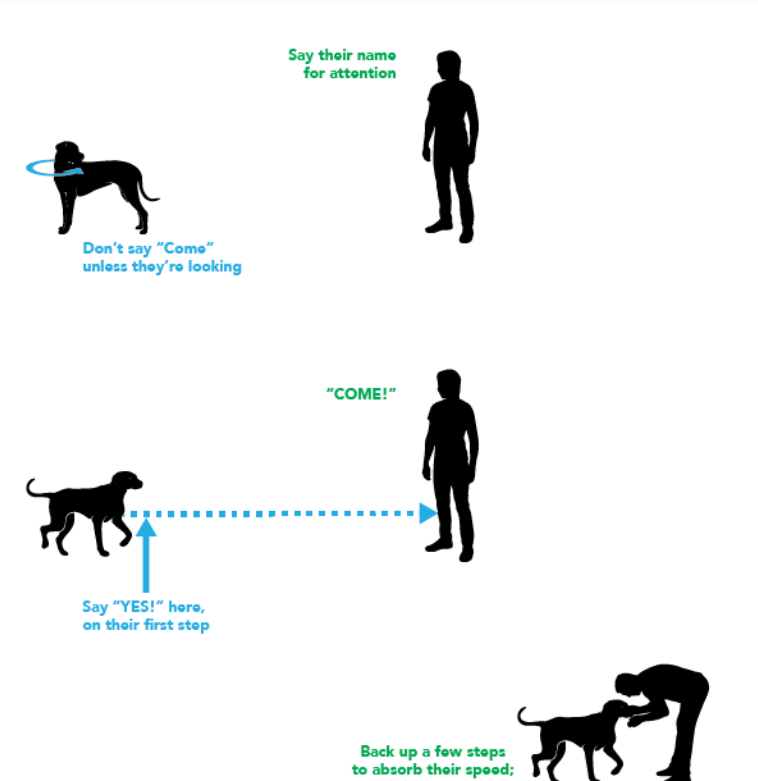
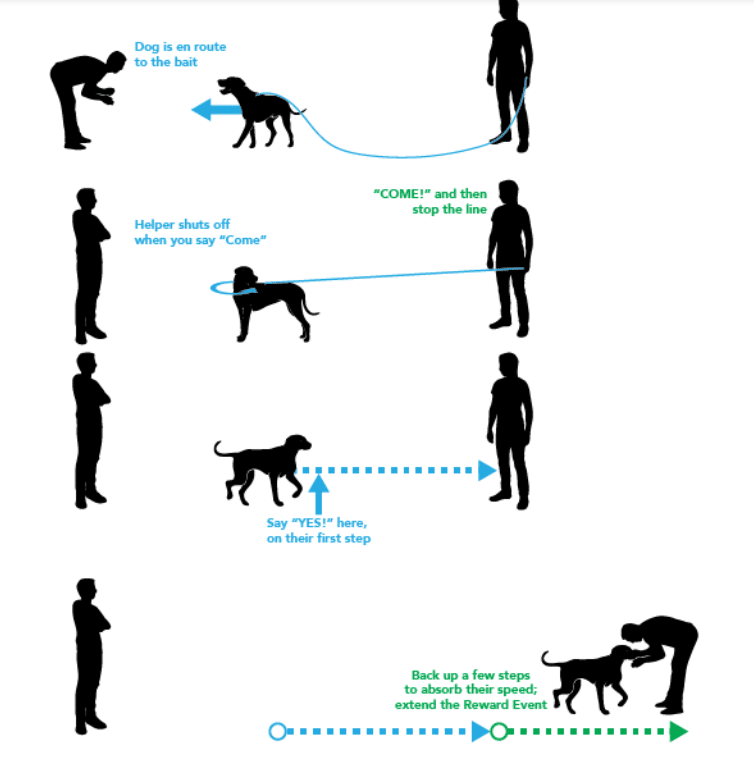
This is where the rubber meets the road. A dog that recalls in your hallway is doing kindergarten. A dog that recalls at the park, around kids, smells, movement, and real-life nonsense? That dog is doing the real work.
Quiet room. Short distance. High-value food. Dog wins fast and often.
Different rooms. Light household activity. Same recall game. Same payoff.
Doorways, patio, garage, front walkway, backyard. This is where dogs suddenly remember smells exist.
20–40 foot cotton lead. Friendly tone. Light leash guidance. Still fenced whenever possible.
Park edge, front yard, mild public spaces, kids playing in the distance, controlled life distractions.
Short park visit. In and out. Win, leave, done.
Same area, same long line, same food, slightly longer exposure.
More environmental noise. Still fair. Still controlled.
More time, more distractions, more difficulty — but never all at once.
Advanced recall is not the dog coming in your kitchen when nothing is happening. Advanced recall is the dog choosing you when something else is more interesting.
Build it fair. Build it gradually. Pay like it matters. And stop expecting graduate-school performance from a dog who just passed preschool.
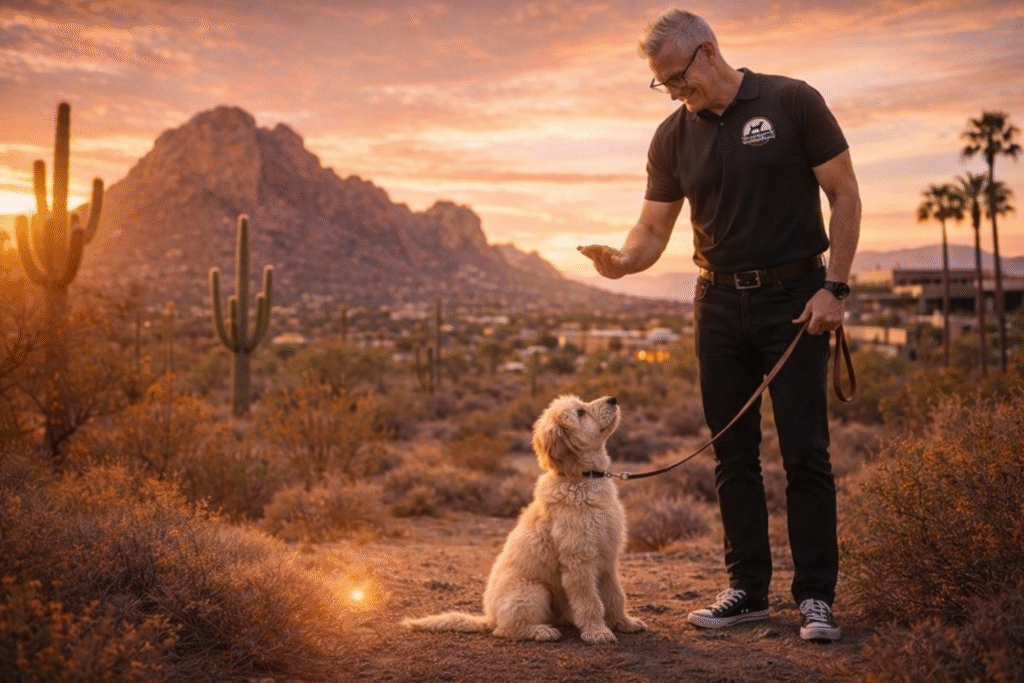
Stay isn’t a trick. It’s the skill that turns “my dog knows commands” into “my dog is safe and predictable.” And yes… we like saying “Staaaaay.” We’re professionals, not robots.
If you skip this, your dog won’t “fail”… you just changed the rules mid-flight.
Tone “Staaaaay” = descending tone (statement, not a question).
Hands Left hand stop-sign + treat hand to chest (same time).
Timing Return to dog’s side BEFORE “YES.” Always.
Progression Duration → Distance → Distractions (never the other way around).
Release “Break, break, break” = mono tone. Calm exit, not a fireworks show.
You don’t mark “YES” from far away. You return to your dog’s side, keep the stop-sign hand up, pause, then: YES → treat → Break, break, break (mono tone).
Skip steps and you’ll teach “stay-ish.” We’re building “stay… even when life is loud.”
If your dog breaks: no drama. Go back to the last successful rep and progress slower.
Have everyone cue: Sit, Down, Come, Come, Come, and Staaaay. Watch hand signals. Listen to tone. Rising tone vs descending tone = two different cues.
Treats (high value), treat pouch, collar + ID, leash. Prepared trainer = predictable dog.
Dog training is people training. Otherwise… you’d just have your dog read this page, right?
You return to your dog’s side before “YES.” Marking from far away often trains “break and come to me.”
Moving back too fast too soon. If your dog breaks, it’s not “stubborn.” You advanced a variable.
Build to: 15 steps back + 15 seconds + return to side → YES → treat → Break.
Your dog must have solid duration + distance before distractions. Distractions are not where we “see what happens.” We already know what happens.
Dogs don’t generalize well. “Living room stay” doesn’t automatically become “squirrel stay.” We earn it.
Reduce distraction. Shorten duration. Step closer. Get a clean win again.
Leash on (yes, inside at first). Cue Sit/Down → Staaay.
Touch knob → return → YES → treat → break.
Crack door 1 inch → same thing.
Open wider only if clean.
If your dog breaks stay and gets what they wanted (door opens, guest greets, forward motion), you just paid them for breaking. We don’t do that here.
Work toward: 1 min → 3 → 5 → 7 → 10.
Not all at once. Not every day. Over time. That’s the point.