Exceptional Canines™ Puppy Development Center • Protocol Page
Soft Mouth Manners + Bite Inhibition (ABI)
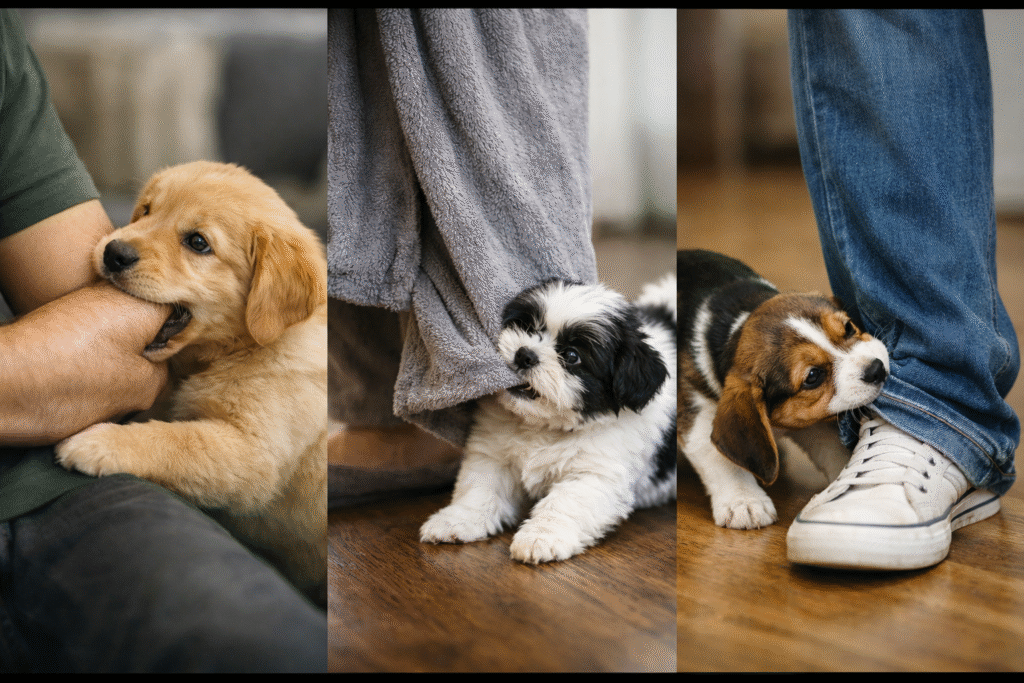
Your puppy isn’t “being bad.” They’re training their mouth — on purpose. The goal isn’t to stop all biting overnight. The goal is to build a dog who has control over their jaws when it actually matters.

Translation: we turn your tiny crocodile into a safe adult dog… without chaos, without wrestling, and without repeating ourselves.
How Dogs Learn
Dogs are tonal, visual, and spatial learners.
Space + posture beat extra words.
What We’re Building
ABI = mouth control.
Good ABI = safer adulthood.
Calm Wins
No intensity.
No chaos.
No wrestling matches.
Command Rule
Say it once.
Give time to think.
Follow through with position.
Read This First
We’re not “stopping biting.” We’re training the mouth.
Puppies play bite because they must receive feedback for their bite pressure so they can acquire the skill of monitoring and adjusting the force of their jaws. That process is what develops Acquired Bite Inhibition (ABI).
Why puppies have razor teeth
They’re not trying to ruin your life.
They’re trying to get a reaction with weak jaw muscles — so they can learn control.

And yes… it feels like you adopted a tiny crocodile with four paws.
The adult-dog reason this matters
Consider this scenario: a dog is asleep in the family room and a toddler accidentally steps on it. A dog with good ABI won’t even make contact. A dog with poor ABI may bite that poor kid — maybe badly.
Bottom line: you don’t want to “stop puppy biting”… because then the bite training stops too.
The Master Key
Intensity comes before frequency (most people miss this)
Intensity → then Frequency
In the correct progression you will see a reduction in intensity before you see a reduction in frequency. This is a training master key.

Biting gets softer and softer before the number of incidents goes down. Force must be trained before frequency — they’re separate variables in the brain, and force has a time limit.
What to look for this week
  • hard bites become “less hard”
  • your OUCH makes the head pull back
  • puppy re-engages softer
  • you’re ending play when needed
AGE LIMITS (Read this. Don’t “wait and see.”)
By about 18 weeks, brain chemistry starts changing and your ABI window begins closing. By six months, it’s pretty much closed.

If you have an 8–9 month old dog jumping up and grabbing sleeves/arms and you haven’t done this work — you’re in a pickle. Off-leash classes, crying out, and “walking away” won’t fix force at that point. You’ll need a different plan.
The 4 Fixes
Try these in order — and actually do the reps
Your puppy is mouthy because they’re young, curious, and obsessed with wrapping their mouth around hands, ankles, sleeves, hair, and anything that moves. You have a head start: littermates already taught some inhibition by yelping and ending the game.

Humans do it softly. Puppies do it loud. We’re going to do it correctly — without triggering prey drive.
Fix #1 — Pattern Interrupt: “OUCH!” (done right)
Say OUCH! loud and sharp enough that your puppy’s head pulls back. Not a long drawn-out “nooooo.” That does nothing.

Rule 1: DO NOT jerk your hand away. Quick movement triggers chase/prey drive and they’ll go harder.
Rule 2: Freeze for a beat. Let the puppy be the one to back off.
Rule 3: The instant they’re softer? Calm praise and keep going.
What you want to see: OUCH → head pulls back → puppy re-engages softer. That’s bite training happening in real time.
Fix #2 — Redirect (fast enough to matter)
If you’re going to redirect, you must replace your hand with a toy immediately. Not 3 seconds later. Not “hold on let me find it.”

Playful puppies have to put something in their mouths. We just make sure it’s not you.
Pro tip: have the toy in your pocket like a responsible adult. (Or at least like someone who wants intact forearms.)
Fix #3 — Leash Play (optional, wildly helpful)
Sometimes I keep the puppy on leash during play so I can step on it and stop the jump-up biting. Step about 12 inches from the collar (shorter for small breeds).

We wait for calm. Then we re-engage.
Why it works: you remove the “launch + bite” option without drama.
Fix #4 — Social Feedback (dogs do it 50x faster)
The first part of meaningful feedback is socialization. Dogs do the work 50x faster and better than we do.

Get your puppy into a well-run play group / day care class as soon as your vet clears it (often after the 2nd round of shots). Or set up play dates with appropriate puppies.

Important: no dog parks. We want controlled, safe, sane dogs — not chaos with fur.
Bail-Out Rules
If the puppy is too jazzed up, we end the game cleanly
If you’re saying OUCH and the puppy is in full gremlin-mode and not responding — we don’t argue. We bail. Simple as that.
Method A — You leave
This is what puppies do with each other: hard bite → yelp → play stops.

You stand up and leave. No lecture. No drama. Come back in 30–60 seconds and try again. If they bite hard again? You leave again.
Method B — Statue Mode
Freeze. Fold your arms across your chest.
You are now a tree. Your branches are closed.

No words. No eye contact. Turn away. Don’t move.
This works because movement is exciting — and stillness ends the party.
Important reality check
We don’t label puppy biting as “bad behavior.” It’s inconvenient — and it’s natural.

Do not scold nature. Train it. Scolding increases stress and kills the ABI learning opportunity.
Climb the Ladder
Softness first → then we reduce incidents
What “progress” actually looks like
  1. Hard bites become less hard.
  2. Biting becomes soft mouthing.
  3. Now we work on frequency using incompatible behaviors (place, sit, leash calm).
  4. Chew toys return as “quiet time tools” — not as your entire training plan.
Don’t set yourself up
  • Don’t get on the floor at puppy level for long sessions
  • Don’t put your face/beard/hair in the bite zone
  • Don’t “play wrestle” and then act surprised
  • Structure beats hope
If you’re open game, your puppy will… play the game.
Normal vs Concerning + Mythbusting
Because the internet is… the internet
Normal play (messy, but normal)
Chasing, pouncing, barking, growling, snapping, biting — plus the classic play bow. Puppies are noisy. Puppies are clumsy. Puppies are learning.
Concerning signs (don’t ignore)
  • Prolonged deep-tone growling
  • Fixed, hard stare
  • Stiff posture + “locked” body
  • Behavior that feels non-spontaneous / not playful
If you see these, don’t guess. Text/email us. We adjust the plan.
Mythbusting (quick hits)
“Leave it / Drop it fixes biting.”
Those are great skills — but they don’t teach ABI. Use them for mouthing after bite inhibition is established.
“Just shout ‘NO BITE!’”
Only works if the dog has been trained on that phrase away from the moment. Otherwise you’re just making noise while getting chewed on.
Tapping the nose / grabbing the muzzle
Great way to create a head-shy puppy and teach them humans are unpredictable. Does nothing for ABI.
Thumb in mouth / smash tongue
No. That’s not training. That’s someone losing their mind on the internet.
Muzzle for mouthy puppy
Prevents mouth learning entirely and can create harder biting later. Puppies need mouth interaction — we just shape it.
“Redirecting solves it.”
Redirecting helps management — but ABI requires feedback. Redirect is a tool, not the whole movie.
Caution: Don’t repeat commands and don’t turn biting into a loud household event.
Calm wins. We give feedback, we stop movement, we enforce structure. We do not start yelling, chasing, or wrestling — that teaches intensity.
Kids + Safety
Protect the dog, protect the kids
Real talk
Kids under 8–9 are not built for consistent behavior modification. Their first reaction to a nip is often to push the puppy away — which the puppy reads as play.

So we manage: structure, supervision, and short controlled interactions.
Family rule
If the puppy is loose, an adult is responsible. If an adult can’t supervise, the puppy is in structure (crate, pen, leash, gated room).
Teach this skill: “When to stay and when to walk away.”
Helpful family videos (optional)
Link 1: The Family Dog – Stop the 77
Link 2: Body language “whispers” vs “shouting”
(If you want, we can swap these to your own hosted videos later.)
Quick Links (Client Area)
Keep your puppy’s world simple, structured, and repeatable. If they’re practicing chaos, they’ll get better at chaos. If they’re practicing structure, they’ll get better at structure.
Exceptional Canines™ • In-home • behavior-first • calm structure • real life proofing

Welcome

tips and tricks For Your Puppy

Submit A Valid Email And Get Our Weekly Newsletter Completely Free