
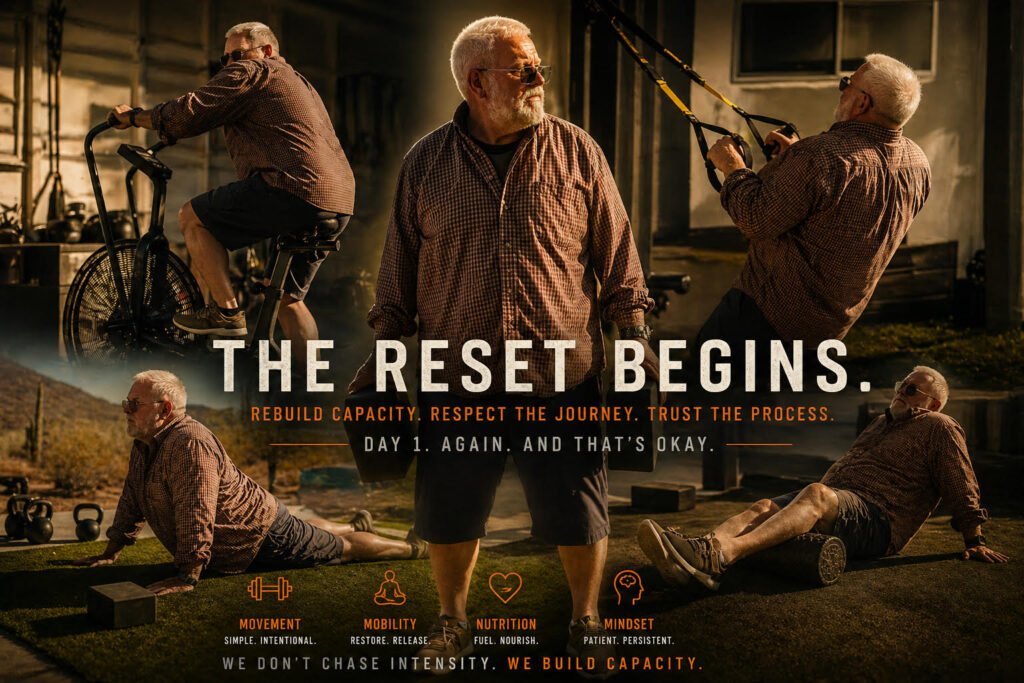
Ross, this section is built for your actual body — not some 28-year-old influencer doing burpees in neon shoes. You’ve had both legs and your back operated on. You are not running. You are not jumping. We are rebuilding capacity with smart, low-impact work that respects your joints, spine, weight, and current conditioning.
If a movement creates sharp pain, nerve symptoms, dizziness, back grabbing, or makes your body feel unsafe, we stop and modify. The mission is not to prove toughness. The mission is to create repeatable wins.
This is the filter for everything we do. If it passes this filter, it stays. If it does not, it goes.
These are the daily anchors. Morning, midday, and evening. Small sessions. Clean reps. No drama.
These are not random extras. These are pressure-release tools during the day.
These are excellent interval ideas, but the original versions are too aggressive for Ross right now. So we keep the concept and modify the delivery.
Original idea: 4 minutes hard, 3 minutes easy, repeated 4 times.
Ross version: we start smaller.
Original idea: 8 rounds of harder interval work.
Ross version: short controlled pushes with plenty of recovery.
This gives Ross structure without turning his life into a spreadsheet hostage situation.
| Day | Main Focus | Details |
|---|---|---|
| Monday | Foundation Cardio | 10–20 min easy bike or pool walk + daily mobility 3x |
| Tuesday | Mobility + Tools | Prone cobra, block stretch, TRX, ROLLGA, yellow band |
| Wednesday | Modified 4x4 | 1 min moderate / 2 min easy x 4 rounds |
| Thursday | Recovery Movement | Easy bike, walking, or pool movement only |
| Friday | Modified Hard Eight | 20–30 sec moderate / 90 sec easy x 6 rounds |
| Saturday | Easy Capacity | 10–20 min low-impact movement |
| Sunday | Reset Day | Mobility only, hydration, sleep, food reset |
Track what you did and how your body responded. This keeps us honest and prevents guessing.
| Date | Mobility 3x? | Conditioning | Back Pain 1–10 | Foot Pain 1–10 | Notes |
|---|---|---|---|---|---|
| ____/____ | ☐ Yes ☐ No | ____________ | ____ | ____ | ____________ |
| ____/____ | ☐ Yes ☐ No | ____________ | ____ | ____ | ____________ |
| ____/____ | ☐ Yes ☐ No | ____________ | ____ | ____ | ____________ |
| ____/____ | ☐ Yes ☐ No | ____________ | ____ | ____ | ____________ |
| ____/____ | ☐ Yes ☐ No | ____________ | ____ | ____ | ____________ |
| ____/____ | ☐ Yes ☐ No | ____________ | ____ | ____ | ____________ |
| ____/____ | ☐ Yes ☐ No | ____________ | ____ | ____ | ____________ |
Ross, this section is built for your actual body — not some 28-year-old influencer doing burpees in neon shoes. You’ve had both legs and your back operated on. You are not running. You are not jumping. We are rebuilding capacity with smart, low-impact work that respects your joints, spine, weight, and current conditioning.
If a movement creates sharp pain, nerve symptoms, dizziness, back grabbing, or makes your body feel unsafe, we stop and modify. The mission is not to prove toughness. The mission is to create repeatable wins.
This is the filter for everything we do. If it passes this filter, it stays. If it does not, it goes.
These are the daily anchors. Morning, midday, and evening. Small sessions. Clean reps. No drama.
These are not random extras. These are pressure-release tools during the day.
These are excellent interval ideas, but the original versions are WAY TO aggressive for you right now. So we keep the concept and modify the delivery.
Original idea: 4 minutes hard, 3 minutes easy, repeated 4 times.
Ross version: we start smaller.
Original idea: 8 rounds of harder interval work.
Ross version: short controlled pushes with plenty of recovery.
This gives Ross structure without turning his life into a spreadsheet hostage situation.
| Day | Main Focus | Details |
|---|---|---|
| Monday | Foundation Cardio | 10–20 min easy bike or pool walk + daily mobility 3x |
| Tuesday | Mobility + Tools | Prone cobra, block stretch, TRX, ROLLGA, yellow band |
| Wednesday | Modified 4x4 | 1 min moderate / 2 min easy x 4 rounds |
| Thursday | Recovery Movement | Easy bike, walking, or pool movement only |
| Friday | Modified Hard Eight | 20–30 sec moderate / 90 sec easy x 6 rounds |
| Saturday | Easy Capacity | 10–20 min low-impact movement |
| Sunday | Reset Day | Mobility only, hydration, sleep, food reset |
Track what you did and how your body responded. This keeps us honest and prevents guessing.
| Date | Mobility 3x? | Conditioning | Back Pain 1–10 | Foot Pain 1–10 | Notes |
|---|---|---|---|---|---|
| ____/____ | ☐ Yes ☐ No | ____________ | ____ | ____ | ____________ |
| ____/____ | ☐ Yes ☐ No | ____________ | ____ | ____ | ____________ |
| ____/____ | ☐ Yes ☐ No | ____________ | ____ | ____ | ____________ |
| ____/____ | ☐ Yes ☐ No | ____________ | ____ | ____ | ____________ |
| ____/____ | ☐ Yes ☐ No | ____________ | ____ | ____ | ____________ |
| ____/____ | ☐ Yes ☐ No | ____________ | ____ | ____ | ____________ |
| ____/____ | ☐ Yes ☐ No | ____________ | ____ | ____ | ____________ |
Ross, this is your portable movement system. The TRX lets you stretch, decompress, move, strengthen, and rebuild confidence almost anywhere: at home, outside, in a hotel room, or on the road. The goal is not to become a Navy SEAL by Friday. The goal is simple: move better without beating your body up.
The TRX is adjustable. That matters. You can make exercises easier by standing more upright, using less body angle, shortening the range, and letting the straps help you instead of fighting gravity alone. For a deconditioned man over 60 with back and leg history, that makes TRX a smart bridge between stretching and strength.
Travel normally destroys routines. TRX solves that. It packs small, anchors to a door or solid overhead point, and gives you guided movement without needing machines, heavy weights, or a perfect schedule.
Keep this simple. Ross does not need a garage gym. He needs a safe anchor, enough space, and a short plan he can repeat.
Use this like a menu. Tight back? Start with Mobility + Stretching. Going on a trip? Use Travel Basics. Want golf mobility? Use the Golf tab. Feeling stronger? Try Beginner Strength.
Featured Ross TRX starting video.
Featured Ross TRX beginner video.
Featured Ross TRX mobility video.
Featured Ross TRX beginner / PT-style video.
Featured Ross TRX golf / functional movement video.
Featured Ross TRX beginner strength video.
One of your chosen starting videos. Keep this as a featured “Ross starts here” option.
Useful for learning basic strap control and beginner-friendly movement.
Good bridge between stretching and beginner strength.
Use on days Ross needs longer flexibility and mobility work.
Good all-levels mobility session for morning or post-work recovery.
Use after easy bike, walking, or TRX strength work to calm the system.
Short, useful menu of movements for warm-up and joint prep.
Strong fit for seniors, beginners, and people returning after injury.
One of your picks. Short, practical, and easier to repeat.
Mobility and closed-chain movement for ankles, hips, thoracic spine, and shoulders.
Senior-focused basics: posture, balance, coordination, and everyday movement.
Great fit for rotation, hips, shoulders, balance, and golf-specific mobility.
Good short golf-focused menu: hip mobility, flexibility, balance, and shoulder control.
Beginner-friendly golf conditioning and mobility concepts.
Rotation, hip hinge, dynamic flexibility, and core activation for better movement.
Use this when Ross is ready for light strengthening without heavy equipment.
Good bridge from mobility into controlled strength patterns.
Only for better days. Ross can do part of it, not all of it.
| Day Type | TRX Focus | Time | Rule |
|---|---|---|---|
| Stiff Back Day | TRX assisted stretch + decompression | 5–8 min | Gentle only |
| Travel Day | Door-anchor mobility flow | 8–12 min | Keep it easy |
| Golf Prep Day | Rotation, hips, shoulders | 8–15 min | No aggressive twisting |
| Strength Day | Rows, assisted squats, hip hinge, chest opener | 10–20 min | Stop before fatigue ruins form |
Use this to track what helped. We are looking for better movement, less stiffness, more confidence, and fewer “my back is running the meeting” days.
| Day | Category | Video Done? | Before Pain 1–10 | After Pain 1–10 | Notes |
|---|---|---|---|---|---|
| Mon | ________ | ☐ Yes ☐ No | ____ | ____ | ________ |
| Tue | ________ | ☐ Yes ☐ No | ____ | ____ | ________ |
| Wed | ________ | ☐ Yes ☐ No | ____ | ____ | ________ |
| Thu | ________ | ☐ Yes ☐ No | ____ | ____ | ________ |
| Fri | ________ | ☐ Yes ☐ No | ____ | ____ | ________ |
| Sat | ________ | ☐ Yes ☐ No | ____ | ____ | ________ |
| Sun | ________ | ☐ Yes ☐ No | ____ | ____ | ________ |
You don’t need to crush TRX workouts.
You don’t need to be perfect.
You just need to use the straps wisely and keep showing up.
Some days this will feel easy.
Some days your body will act like it wants to file a complaint with management.
Both days count.
Ross, this is the food side of the reset. We are not trying to make nutrition complicated. We are removing the obvious inflammatory troublemakers, building meals around protein, and giving your body fewer problems to fight every single day.
For 30 days, the mission is clean: real food, protein first, hydration, electrolytes, no processed junk, and no food confusion. This is not diet religion. This is a reset.
This keeps the information clean without turning Ross into a full-time nutrition researcher with a steak subscription.
This is the starting protocol. Simple, repeatable, and focused on lowering inflammation.
When carbs drop, the body can dump water and minerals. This is where people get headaches, cramps, fatigue, and then blame the plan instead of the missing salt.
This is optional for strict carnivore, but useful for a hybrid longevity stack if tolerated.
This gives Ross options without turning food into a theological debate.
The first week can feel strange because the body is switching fuel systems and detoxing from processed-food habits.
Track what matters. This keeps the plan grounded in real feedback instead of guesswork.
| Date | Clean Food? | Water / Electrolytes? | Back Pain 1–10 | Foot Pain 1–10 | Energy 1–10 | Notes |
|---|---|---|---|---|---|---|
| ____/____ | ☐ Yes ☐ No | ☐ Yes ☐ No | ____ | ____ | ____ | ____________ |
| ____/____ | ☐ Yes ☐ No | ☐ Yes ☐ No | ____ | ____ | ____ | ____________ |
| ____/____ | ☐ Yes ☐ No | ☐ Yes ☐ No | ____ | ____ | ____ | ____________ |
| ____/____ | ☐ Yes ☐ No | ☐ Yes ☐ No | ____ | ____ | ____ | ____________ |
| ____/____ | ☐ Yes ☐ No | ☐ Yes ☐ No | ____ | ____ | ____ | ____________ |
| ____/____ | ☐ Yes ☐ No | ☐ Yes ☐ No | ____ | ____ | ____ | ____________ |
| ____/____ | ☐ Yes ☐ No | ☐ Yes ☐ No | ____ | ____ | ____ | ____________ |
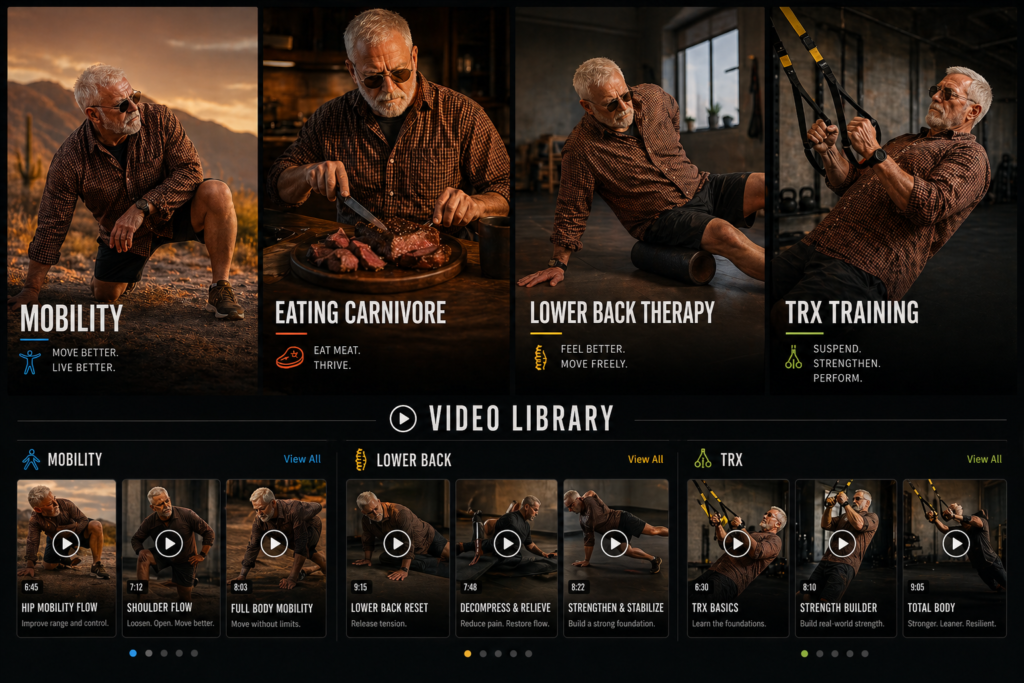
Ross, this is your “my back is tight — what do I do?” section. These videos cover psoas, hip flexors, Thomas stretch, couch/wall stretch, icing, heat, and what to do when you overdid it.
Tight hip flexors can feed lower back pressure, but yanking on them like a lawn mower cord is not the answer. We want release, mobility, control, breathing, and smart recovery.
The psoas and hip flexors connect the trunk, pelvis, and legs. When they are tight, weak, guarded, or overworked, they can contribute to lower back pressure, poor posture, and that locked-up feeling after sitting.
Use these first when Ross needs simple, calm, follow-along movement.
One of your selected videos. Good slot for the practical “watch and do” section.
Supports the hip-to-low-back connection without making Ross guess what to do.
Short follow-along routine for tight hips and low back pain.
Use when Ross has more time and needs a full mobility reset.
The Thomas stretch/test helps Ross understand whether hip flexors are pulling on the pelvis and feeding lower-back pressure.
Good visual explanation of the Thomas test for hip flexor/iliopsoas tightness.
Useful for a safer, more controlled version of the test.
Good option if Ross needs support and better control.
This is useful but can be too aggressive. Ross starts with a chair/couch version before the wall version.
Clear demonstration of the couch stretch pattern.
Good general tutorial for the stretch. Modify heavily for Ross.
Connects hip flexor work to back and knee tension.
This is the missing piece: psoas may feel tight because it is weak, guarded, or overworked. Stretching alone is not always the fix.
Important concept: Ross needs release plus control, not endless stretching.
Good for combining soft tissue ideas with exercise-based solutions.
Useful for explaining why tightness keeps coming back.
This is the recovery row. Ross needs to know when to ice, when to heat, and how not to make a flare-up worse.
Practical guidance on choosing cold or heat for lower-back pain.
Good reality check: heat and ice can help symptoms, but they are tools, not miracles.
Useful for Ross when he is unsure what to use after a flare-up.
Good positioning demo for safe lower-back heat application.
| Time | What To Do | How Long | Notes |
|---|---|---|---|
| Morning | Gentle hip flexor / psoas mobility + prone cobra | 5–8 min | Easy range. No forcing. |
| Midday | Chair/couch stretch or Thomas stretch variation | 2–5 min | Short holds. Stay tall. |
| Evening | TRX decompression + gentle mobility | 5–10 min | Calm the back before bed. |
| Flare-Up | Ice or heat based on symptoms, then gentle movement | 10–15 min | No direct ice on skin. |
Ross, this is the “my back is tight — what do I watch and do?” section. This library covers hip flexors, psoas, Thomas stretch, couch stretch, abdominal wall tone, inner-unit stability, foam rolling, ROLLGA, Theragun, ice, heat, and flare-up recovery.
Tightness is not always a stretching problem. Sometimes it is weakness, guarding, poor breathing, poor abdominal wall support, or too much inflammation. The goal is release + control + recovery.
This row gives the deeper “why.” The back is not separate from the abdominal wall, breathing, organs, pelvis, hips, and the inner stabilizing system.
Important for understanding how abdominal tone affects posture, breathing, and back support.
Explains why endless crunches are not the answer and why the abdominal wall must function intelligently.
Higher-level core concept. Not necessarily Ross’s starting exercise, but excellent education.
Inner-unit stability concept connected to CHEK-style back training and spinal support.
One of your selected videos. Good practical “watch and do” video for Ross.
Supports the hip-to-low-back connection without making Ross guess.
Short follow-along routine for tight hips and back pressure.
Good visual explanation of the Thomas test for hip flexor/iliopsoas tightness.
Useful for a safer, more controlled test version.
Good option if Ross needs support and better control.
Clear demonstration of the couch stretch pattern.
Good general tutorial. Modify heavily for Ross.
Connects hip flexor work to back and knee tension.
Critical concept: Ross needs release plus control, not endless stretching.
Good blend of soft tissue ideas and exercise-based solutions.
Useful for explaining why tightness keeps coming back.
Use around the back — glutes, hips, hamstrings, mid-back. Avoid direct spine pressure.
Good ROLLGA-specific demo for back relief.
Best Ross-safe option because wall pressure is easier to control.
Important concept: roll around the problem, not directly into the spine.
Practical lower-back-specific guidance on choosing ice or heat.
Good reality check on what heat and ice can and cannot do.
Useful when Ross is unsure what to use after a flare-up.
Ross, this is the tool section: Theragun, ROLLGA, foam roller, ice, heat, and what to do when your back feels like it sent a strongly worded email to management.
These tools are support players. They help calm tissue, reduce guarding, improve comfort, and make movement easier. The real win is using them briefly, then moving gently.
Use the right tool for the right job. Randomly attacking the back with gadgets is not a recovery plan.
Massage guns can be useful, but Ross should avoid direct spine work and focus on the muscles around the hips, glutes, quads, hamstrings, and upper/mid-back.
Good basic introduction to using a massage gun for back-pain relief.
Useful setup for lower-back-adjacent work. Ross still avoids direct spine pressure.
Helpful for learning self-use without needing someone else to hold the tool.
ROLLGA is useful because its shape can spare bony areas and target muscles more comfortably. For Ross, wall-based rolling may be safer than floor-based rolling at first.
Specific ROLLGA back-relief demo. Use gently and avoid direct aggressive low-back pressure.
Great Ross-safe option because the wall lets him control pressure without getting stuck on the floor.
Glutes can feed back pain. This is a useful lower-back-adjacent target.
Best starting point if Ross needs control and less bodyweight pressure.
Foam rolling can help, but lower-back pain often responds better when Ross rolls the surrounding areas: glutes, hips, quads, hamstrings, and mid-back.
Important concept: don’t just grind directly into the low back. Work around the problem.
Use as education, but keep Ross conservative and symptom-guided.
Better target for Ross: hips and surrounding tissue instead of direct spine pressure.
Glute tension can contribute to back discomfort. This is a safer target area.
Use this row when Ross overdid it, feels inflamed, or needs to understand whether cold or heat makes more sense.
Practical lower-back-specific guidance on choosing ice or heat.
Good reality check on what heat and ice can and cannot do.
Useful when Ross is unsure what to use after a flare-up.
Bob & Brad-style explanation of when people misuse heat or ice.
This row helps Ross set up ice correctly so he doesn’t just slap frozen peas on his back and hope the universe fixes him.
Physical therapy recipe for making a flexible ice pack.
Another Bob & Brad-style option for an at-home cold pack.
Useful if symptoms feel sciatic or nerve-related. Modify carefully.
This is the “oops, I did too much” plan.
| Situation | First Move | Then | Avoid |
|---|---|---|---|
| Back feels hot / irritated | Ice 10–15 min | Gentle walk or mobility | Stretching aggressively |
| Back feels stiff / guarded | Heat 10–15 min | TRX decompression or gentle mobility | Long sitting after heat |
| Hips feel tight | ROLLGA wall / glute work | Short psoas or couch stretch | Grinding low back directly |
| Sore after intervals | Easy movement + hydration | Ice or heat based on symptoms | Another hard workout |
Ross, this is your “just press play” section. When your back is stiff, your hips feel like concrete, or your motivation has left the building without forwarding its mail, come here.
She teaches movement in a calm, practical way. No screaming. No circus tricks. No “beast mode before breakfast.” Just small, smart sessions that help you move better, trust your body again, and stack wins without getting wrecked.
Starting over at this stage is no small thing. Losing 100+ pounds, rebuilding strength, and learning to move again takes patience. So we are not looking for perfect. We are looking for repeatable.
Back tight? Start with Back + Hips. Need an easy win? Daily Flow. Feeling ready for more structure? Core + Posture.
For the “I can do three minutes” days. Those count.
Great daily reset for stiffness and low-back pressure.
Use on better days when you have a little more gas in the tank.
Back talking? Start here before it writes a novel.
Good when hip stiffness feeds lower-back pressure.
A calmer option for sore, stiff days.
Posture, spine movement, and core control without madness.
Simple core work that respects the back.
Watch this so you don’t accidentally turn “core day” into “back regret day.”
Beginner-friendly strength for standing taller and moving better.
Great after sitting, traveling, or feeling like a human folding chair.
Use gently and only within pain-free range.
Use this if you want to browse by category later.
Link: Open Playlists
Use this to see newer or featured videos.
Link: Open Featured Page
| Day | Category | Video Done? | Before Pain | After Pain | Notes |
|---|---|---|---|---|---|
| Mon | ________ | ☐ Yes ☐ No | ____ | ____ | ________ |
| Tue | ________ | ☐ Yes ☐ No | ____ | ____ | ________ |
| Wed | ________ | ☐ Yes ☐ No | ____ | ____ | ________ |
| Thu | ________ | ☐ Yes ☐ No | ____ | ____ | ________ |
| Fri | ________ | ☐ Yes ☐ No | ____ | ____ | ________ |
| Sat | ________ | ☐ Yes ☐ No | ____ | ____ | ________ |
| Sun | ________ | ☐ Yes ☐ No | ____ | ____ | ________ |